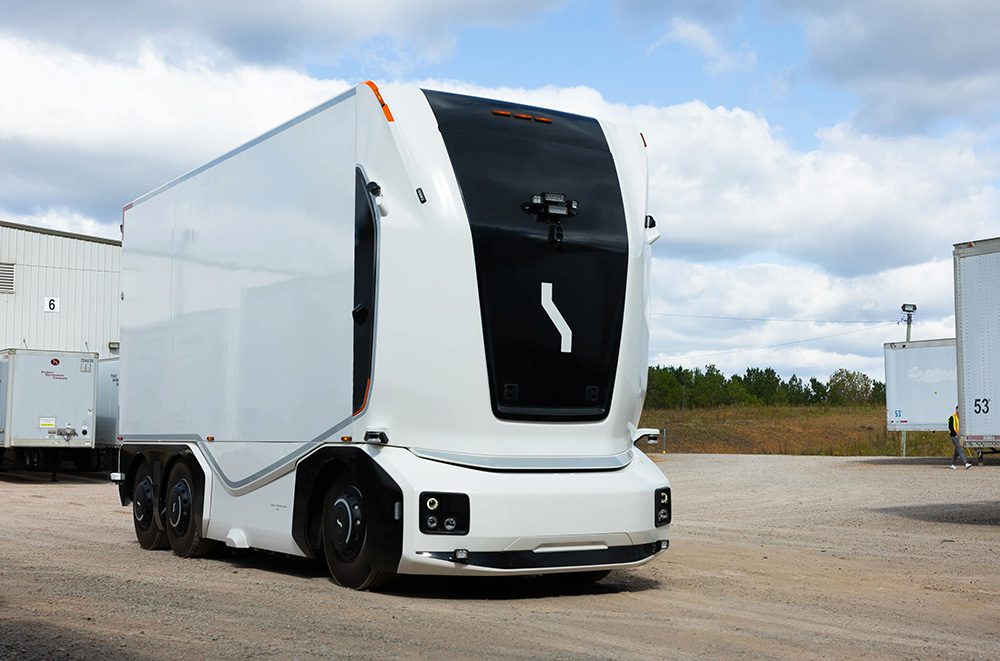
Technical Battery-Centric Analysis of the Einride Autonomous Electric Truck Deployment
The source article is fundamentally about autonomous freight operations, not a battery disclosure. However, because the vehicles are described as cab-less electric heavy-duty trucks engaged in daily logistics service, the system-level constraints are dominated by the traction battery pack, its thermal architecture, and its ability to support repeated high-energy and potentially high-power duty cycles.
Because no cell chemistry is explicitly stated, the most defensible engineering interpretation is an assumed heavy-duty commercial EV battery pack based on LFP or high-nickel NMC, with LFP being the more likely fleet-oriented choice when lifecycle durability, safety margin, and cost are prioritized. Below is a technical teardown of the likely energy-storage implications.
1. Assumed Cell Chemistry and Intrinsic Limitations
1.1 Most probable chemistry: LFP, with NMC as an alternate fleet-optimization choice
For autonomous freight tractors used in repetitive logistics routes, the chemistry selection is usually governed by:
- Cycle life
- Thermal abuse tolerance
- Total cost per kWh
- Pack-level safety and serviceability
- Charging strategy and depot infrastructure
Given those constraints, LFP (LiFePO₄) is the most likely chemistry in a duty cycle such as warehouse-to-warehouse shuttle service. The reasons are structural:
- Lower material cost than high-nickel chemistries
- Excellent cycle life in partial-state-of-charge operation
- Superior thermal stability and lower oxygen release propensity during abuse
- Better tolerance to fleet-duty calendar/cycle combinations
An NMC variant remains plausible if the truck targets a higher gravimetric energy density to extend range while minimizing pack mass. But for depot-based freight applications, LFP’s lower specific energy is often acceptable because vehicle packaging can accommodate a larger battery enclosure.
1.2 Intrinsic limitations of LFP
If the platform uses LFP, the main cell-level limitations are:
Lower gravimetric and volumetric energy density
LFP typically sacrifices energy density relative to NMC. For heavy-duty trucks, this translates into:
- Greater pack mass for a given usable range
- Larger enclosure volume
- More structural demand on chassis integration
- Increased rolling resistance and reduced payload margin
This is not merely a packaging issue; it also increases thermal inertia and charging time at depot power levels.
Voltage plateau and SOC observability
LFP exhibits a notably flat OCV-SOC curve through a large mid-SOC region. That makes:
- SOC estimation more difficult under dynamic load
- BMS calibration more dependent on current counting and model-based observers
- Error accumulation more likely during high C-rate operation and temperature swings
In autonomous fleet operations, reliable SOC prediction is operationally critical because route completion and remote dispatch decisions may depend on it.
Low-temperature charge acceptance
A major LFP weakness is reduced chargeability at low cell temperatures. The lithium diffusion kinetics slow sharply, raising:
- Internal polarization
- Anode overpotential
- Lithium plating risk during fast charge
Commercial trucks operating in Ohio will encounter seasonally cold ambient conditions, so preconditioning becomes a mandatory requirement.
1.3 Intrinsic limitations of NMC, if used instead
If the pack instead uses NMC, the trade space shifts:
Higher energy density, but narrower thermal margin
NMC supports better range per unit mass, but:
- Cathode stability is lower than LFP
- Thermal runaway onset is more concerning under abuse
- Heat generation under high-power cycling can be more severe due to impedance and entropic heat characteristics
Greater sensitivity to high SOC storage
Fleet vehicles often dwell near high SOC for operational readiness. NMC suffers accelerated degradation mechanisms at high SOC, including:
- Electrolyte oxidation
- Cathode microcracking
- Impedance rise
- Transition-metal dissolution
This is especially relevant for depot-charged vehicles that may remain parked fully charged before dispatch.
1.4 Solid-state is unlikely in this deployment context
A solid-state traction battery is not a realistic assumption here. Despite its theoretical advantages, current solid-state technology faces:
- Interfacial resistance issues
- Mechanical stack-pressure management challenges
- Limited maturity for heavy-duty commercial duty cycles
- Scaling and cost constraints
For this use case, conventional liquid-electrolyte cells remain overwhelmingly more probable.
2. Theoretical Thermal Management Challenges
2.1 Heavy-duty autonomous trucks create a uniquely difficult thermal envelope
Unlike passenger EVs, autonomous freight vehicles can experience:
- High continuous power draw
- Long-duration highway loads
- Repeated charge/discharge cycling
- Limited passive cooling margin due to enclosed underbody packaging
- Additional thermal load from compute, sensors, and power electronics
Battery thermal management is therefore not only about preventing runaway; it is about preserving cell-to-cell uniformity, minimizing resistance growth, and ensuring repeatable charge acceptance.
2.2 Liquid cooling plate design constraints
For a heavy-duty pack, liquid cold plates are the dominant architecture. The design challenge is not simply removing average heat; it is controlling spatial gradients.
Key engineering variables
- Coolant flow rate
- Channel geometry
- Plate conductivity
- Contact resistance between module and cold plate
- Manifold uniformity
- Series-parallel coolant routing
Failure mode: longitudinal coolant temperature rise
If the pack uses a serial coolant path, inlet cells close to the manifold see colder coolant than downstream cells. This creates:
- A thermal gradient across modules
- Non-uniform aging
- Localized SOH divergence
- Unequal resistance growth and charge acceptance
In a long truck battery enclosure, this effect can be pronounced unless the cold plate is carefully segmented or flow-balanced.
Failure mode: poor interface conductance
Even if coolant-side thermal design is good, the pack can still suffer if the interface between cell/module and cold plate is weak. Common bottlenecks include:
- Uneven TIM thickness
- Compression loss over life
- Warpage of module substrates
- Local air gaps after mechanical shock or thermal cycling
The result is the creation of “hot cells” that age faster than the pack average.
2.3 Thermal gradients and pack balancing implications
Thermal gradients directly influence electrochemical behavior:
- Cold cells have higher impedance and lower usable power
- Hot cells age faster and may approach gas-generation thresholds sooner
- Balancing circuits may be forced to work harder because cell divergence grows with temperature spread
For a fleet vehicle, even a modest gradient can cause operational inconsistency from truck to truck and route to route.
A well-designed system typically aims for:
- Minimal intra-pack delta-T
- Symmetry in coolant distribution
- High thermal conductivity spreaders under modules
- Accurate distributed temperature sensing
2.4 Tab cooling vs. surface cooling
This distinction is critical for high-power EV packs.
Surface cooling
Surface cooling extracts heat through the broad face of the cell or module. This is common in prismatic and pouch-based architectures and works well when:
- Cell geometry provides large contact area
- Thermal interface material is optimized
- Heat flux is moderate and uniform
However, surface cooling can be insufficient because the electrochemical heat source is distributed internally, while the highest current density and ohmic losses often cluster near current collectors and tabs.
Tab cooling
In high-power cells, tabs can become a localized thermal bottleneck due to:
- Current crowding
- Joule heating in the collector and weld region
- Elevated resistance at mechanical joints
Tab cooling can help suppress local hot spots, especially during fast charge and repeated high-power discharge.
But tab cooling introduces complexity:
- Additional mechanical interfaces
- More difficult sealing
- Higher manufacturing variability
- Potential reliability concerns under vibration in trucking duty cycles
Engineering reality
For truck applications, the best solution is often not “tab cooling or surface cooling,” but a hybrid thermal strategy combining:
- Surface heat extraction for bulk temperature control
- Localized thermal spreading near tabs/busbars
- Robust coolant plate architecture
- Low-resistance interconnect design
2.5 Power electronics and auxiliary heat load
Autonomous trucks also add thermal stress outside the battery itself:
- DC-DC converters
- Traction inverter
- Onboard compute
- Lidars, cameras, radar, and data systems
- HVAC demands for electronics enclosures
This matters because the battery thermal system may be sharing coolant loops or operating in a vehicle-level thermal network. If waste heat is not well isolated, concentrated thermal loads can feed back into battery pack temperature stability.
3. Fast-Charging Constraints
3.1 Fast charging is limited by ion transport, not just charger power
Heavy-duty fleet depots often want rapid turnaround, but battery fast charging is constrained by:
- Electrolyte ionic conductivity
- Solid-phase diffusion in electrodes
- Charge transfer kinetics
- Cell internal resistance
- Thermal management capability
At the pack level, charger power is only useful if the cells can accept it without exceeding safe intercalation limits.
3.2 Ionic conductivity and polarization limits
As charging current rises, ionic transport through the electrolyte and porous electrodes becomes increasingly difficult. Consequences include:
- Increased concentration polarization
- Larger overpotential at the graphite anode
- Non-uniform lithium intercalation
- Local depletion of lithium ions near the anode surface
This is especially problematic in thick electrodes, which are common in cost-optimized heavy-duty packs because they reduce manufacturing cost per kWh but worsen rate capability.
3.3 Lithium plating risk at high C-rates
The principal fast-charge failure mode is lithium plating on the graphite anode. This is triggered when:
- Anode potential falls too close to 0 V vs. Li/Li+
- Low temperature reduces diffusion kinetics
- High SOC increases anode saturation
- Fast charge current exceeds usable intercalation rate
Why plating matters
Plated lithium can:
- Reduce cyclable lithium inventory, causing irreversible capacity loss
- Form dendritic structures
- Increase internal impedance
- Raise short-circuit risk under repeated cycling
For cold-weather Ohio operation, this risk is not theoretical. If the truck arrives at a depot after a route in winter and is fast-charged without sufficient preconditioning, plating probability increases materially.
3.4 Chemistry dependence of fast-charge tolerance
LFP
LFP is generally safer thermally, but it does not eliminate fast-charge constraints. In fact, because fleet operators often push LFP packs toward full utilization to maximize cycle economics, the pack may still see:
- High current
- Cold-charge conditions
- Limited headroom near full SOC
LFP’s flat voltage profile can also make it harder for the BMS to infer the true electrochemical state during charge tapering.
NMC
NMC can offer better energy density, but high-nickel cells often have:
- Greater thermal sensitivity
- More pronounced degradation at elevated temperature
- Strong dependence on precise charge control to avoid accelerated aging
Thus, if the system uses NMC, charge strategies typically need tighter thermal and SOC windows.
3.5 Required mitigation measures for depot fast charging
A robust heavy-duty EV charging strategy generally requires:
- Active battery preconditioning before charge initiation
- Charge-current limits based on cell temperature and SOC
- Conservative taper control near high SOC
- Pack-level and module-level temperature sensing density
- Algorithmic prevention of cold fast charging
- Possibly regionalized charging zones within the pack if thermal gradients are significant
4. System-Level Engineering Implications for Autonomous Freight
4.1 Battery reliability is now an uptime variable
For autonomous freight, battery performance affects not only range but also:
- Route adherence
- Remote intervention frequency
- Dispatch predictability
- Fleet utilization
- Safety case robustness
A battery pack with poor thermal uniformity or weak fast-charge performance will undermine autonomy economics even if the autonomous stack is technically sound.
4.2 Fleet duty cycle favors conservative electrochemical design
Warehouse-to-warehouse trucking typically rewards:
- Moderate power density
- Long cycle life
- Robust thermal stability
- Predictable charge behavior
- Simplified maintenance
That means the likely design bias is toward an LFP-based pack with strong liquid cooling and a BMS optimized for controlled depot charging rather than ultra-high energy density or aggressive public DC fast-charging behavior.
5. Bottom-Line Engineering Assessment
From a battery engineering standpoint, the article implies a commercial heavy-duty EV platform whose success depends less on autonomy itself and more on pack durability, thermal homogeneity, and controlled charge acceptance.
Likely battery architecture
- Most probable chemistry: LFP
- Alternative if range-mass tradeoff dominates: NMC
- Unlikely: solid-state
Core technical constraints
- LFP offers safety and cycle-life advantages but lower energy density and weaker cold-charge performance
- NMC offers better energy density but tighter thermal and aging constraints
- Liquid cooling must minimize cell-to-cell gradient and coolant inlet/outlet asymmetry
- Tab-region heating and interconnect losses can create localized hot spots
- Fast charging is bounded by ionic transport and lithium plating risk, especially in cold conditions and at high SOC
If you want, I can also convert this into a battery teardown-style template with sections like cell format, pack architecture, thermal path, BMS strategy, and degradation prognosis.