Technical Interpretation of the Core Technology
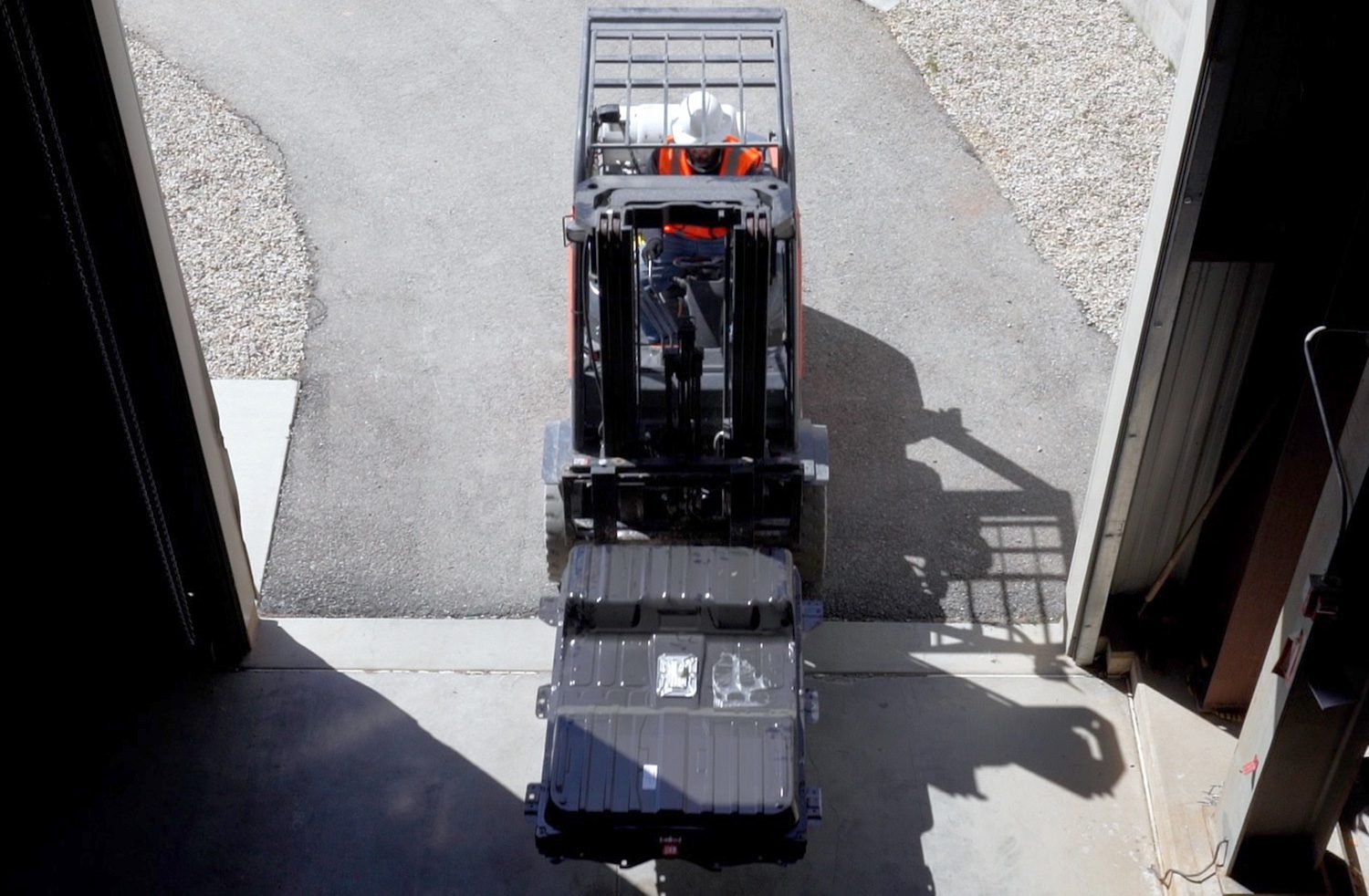
The article describes a second-life EV battery repurposing architecture: retired traction battery packs from an autonomous vehicle fleet are screened, requalified, reconfigured, and deployed into stationary battery energy storage systems (BESS) for grid services. From an engineering standpoint, the value proposition is not in “energy storage” itself, but in extracting additional usable lifetime from an already capitalized electrochemical asset before final recycling.
For a teardown engineer, the critical questions are:
- What cell chemistry is likely inside these packs?
- How does the pack architecture tolerate a second-life duty cycle?
- What are the thermal and electrochemical constraints that define usable residual capacity?
- Why can second-life batteries be acceptable for stationary storage but unsuitable for continued automotive use?
1) Assumed Cell Chemistry and Intrinsic Limitations
Likely Chemistry: NMC/NCA-Like Automotive Cells, Possibly LFP in Some Generational Mix
The article does not identify the chemistry. However, for an autonomous EV fleet operating in North America, the most probable chemistries are:
- NMC (nickel-manganese-cobalt oxide)
- NCA (nickel-cobalt-aluminum oxide)
- Less likely but possible in some vehicle classes: LFP (lithium iron phosphate)
Why NMC/NCA is the most likely assumption
For robotaxi or autonomous fleet applications, the pack is usually optimized for:
- High gravimetric and volumetric energy density
- Moderate-to-high power capability
- Long cycle life under controlled fleet charging
- Strong software-managed thermal conditioning
These priorities historically align with high-nickel layered oxide chemistries rather than LFP, especially if vehicle range and payload efficiency are important.
Why LFP is still plausible
If the fleet is from a newer cost-optimized platform, LFP is plausible because:
- Lower cost per kWh
- Better thermal stability
- Longer calendar/cycle life in stationary service
But LFP’s lower energy density generally penalizes pack mass and volume, which is less attractive for vehicles where platform efficiency matters.
Intrinsic Limitations of the Likely Chemistries
If the cells are NMC/NCA
The main limitations are:
1. Thermal instability at elevated state of charge
Layered nickel-rich cathodes exhibit stronger oxygen release tendencies at high SOC and high temperature. Even though second-life stationary operation is milder than automotive fast transients, aged NMC/NCA cells retain a narrower abuse margin as:
- SEI thickens
- impedance rises
- lithium inventory is lost
- cell-to-cell variability increases
2. Calendar aging sensitivity
Nickel-rich chemistries are especially vulnerable to:
- electrolyte oxidation at high voltage
- cathode microcracking
- transition-metal dissolution
- gas generation
- loss of active lithium
In second-life storage, these cells may still function well if operated in restricted SOC windows, but their remaining life is highly dependent on operating voltage ceiling and temperature control.
3. Lithium plating risk under low-temperature charging
If any form of fast charge or cold ambient charging is part of the pre-processing or stationary recharge profile, NMC/NCA cells are vulnerable to Li plating whenever the graphite anode potential approaches 0 V vs. Li/Li⁺.
If the cells are LFP
LFP has advantages for stationary reuse, but its limitations are different:
1. Lower cell voltage and energy density
- Nominal cell voltage is ~3.2 V vs. ~3.6–3.7 V for NMC/NCA
- Lower specific energy means larger footprint for the same usable kWh
2. Flat OCV-SOC curve complicates state estimation
A major challenge in second-life BESS is SOC calibration. LFP’s flat voltage plateau makes it difficult to infer SOC from voltage alone, especially in aged cells with ill-defined capacity and hysteresis.
3. Lower temperature operating efficiency at cold conditions
LFP generally tolerates abuse well but has poorer low-temperature kinetics than many engineers assume. At cold temperatures:
- charge transfer resistance rises
- diffusion becomes sluggish
- useful charge power is strongly curtailed
4. Degraded fast-charge tolerance in aged form
Even though fresh LFP is comparatively robust, aged LFP undergoes:
- electrolyte depletion
- SEI thickening
- impedance growth
- local inhomogeneity across cells
So the chemistry may still be thermally safe, but it is not immune to rate-induced degradation.
Chemistry-Relevant Implication for Second-Life BESS
A second-life system is usually constrained by the weakest cells in the population, not by nominal chemistry alone. After automotive retirement, pack heterogeneity dominates:
- capacity spread
- internal resistance spread
- self-discharge divergence
- thermal asymmetry
- latent defect accumulation
Therefore, the electrochemical suitability of second-life batteries is less about “fresh chemistry” and more about distribution of aged cell parameters.
2) Theoretical Thermal Management Challenges
Stationary Reuse Changes the Thermal Boundary Conditions, Not the Electrochemical Physics
In vehicle service, the pack experiences:
- high transient power
- variable ambient conditions
- frequent thermal cycles
- vibration and mechanical shock
- highly integrated liquid thermal management
In stationary service, vibration is removed, but thermal challenges remain—and in some cases worsen because the cells now operate in enclosures with lower airflow diversity and longer dwell times at elevated SOC.
Liquid Cooling Plate Design Considerations
If the original automotive pack used liquid cooling plates, second-life reuse introduces several engineering issues:
1. Thermal contact degradation after pack disassembly
Once packs are repurposed, cell-to-cold-plate interfaces may no longer be pristine. Repackaging often introduces:
- re-adhesion layers
- changed compressive loading
- nonuniform pad thickness
- weakened gap filler performance
This matters because a modest increase in interface thermal resistance can produce a major rise in core temperature under sustained load.
2. Nonuniform plate pressure field
Liquid plates only work well when the contact pressure is evenly distributed. Reuse architectures often struggle with:
- warped modules
- aged potting compounds
- frame distortion
- inconsistent clamping
Any pressure nonuniformity creates thermal hot spots and local aging acceleration.
3. Coolant channel maldistribution
If stationary systems retain liquid cooling, the manifold design must avoid:
- flow bypass
- Reynolds number variability across parallel branches
- local stagnation zones
- entrance/exit maldistribution
Second-life arrays are often assembled from heterogeneous sources, so module-level power dissipation may vary significantly, creating a mismatch between thermal load and coolant path geometry.
Thermal Gradient Risks
Why Thermal Gradients Matter More in Second Life
Aged cells exhibit higher DCIR and greater parameter spread. Under the same current, hotter cells age faster, and more resistive cells heat more. This creates a positive feedback loop:
- One cell develops slightly higher resistance.
- That cell dissipates more I²R heat.
- Local temperature rises.
- Degradation accelerates.
- Resistance rises further.
This is the classic electro-thermal runaway toward imbalance, even at stationary power levels that seem modest.
Key thermal failure modes
- Cell-to-cell temperature deltas
- Module edge effects
- Center-pack heat accumulation
- Uneven coolant pickup
- Temperature stratification during low-airflow operation
In BESS applications, the target is usually not extreme peak power but uniform long-duration operation. Thermal gradient control is therefore more important than raw cooling capacity.
Tab Cooling vs. Surface Cooling
Tab Cooling
Tab cooling directly extracts heat from the collector tabs, which is useful because:
- tabs are local current-concentration points
- ohmic and contact losses are concentrated there
- thermal extraction near the tab can suppress current-collector hot spots
Advantages
- targets high-resistance interfaces
- can lower localized temperature rise
- effective for high-rate operation
Limitations
- tabs are only part of the heat path; bulk jellyroll/core heat remains
- difficult to implement uniformly across repurposed modules
- adds mechanical complexity and manufacturing variation risk
Surface Cooling
Surface cooling through cold plates or forced convection acts on the module face or casing.
Advantages
- simpler integration into BESS racks
- more scalable in containerized storage
- useful for moderate C-rate stationary duty
Limitations
- thermal path from electrode core to case can be long
- aged cells have greater internal heat generation
- hot spots can persist in the cell core even when the case looks cool
Engineering Tradeoff in Second-Life Packs
For second-life storage, surface cooling is usually adequate only if operating C-rates are low and the SOC window is narrow. If the system is asked to perform frequent grid support services like:
- frequency regulation
- peak shaving
- ramp-rate control
then tab-level heat extraction and/or aggressive liquid cooling becomes much more attractive.
However, repurposed packs rarely justify the cost and complexity of a full OEM-grade thermal architecture. Therefore, the system designer must strike a balance between:
- thermal uniformity
- reuse cost
- electrical derating
- maintenance access
- safety instrumentation density
3) Fast-Charging Constraints Relevant to Second-Life EV Batteries
Fast Charging Is Usually Not the Primary Stationary Use Case, But It Still Matters
Even though the repurposed batteries in BESS may not be “fast charged” in the automotive sense, high-power grid operation can impose high charge/discharge C-rates. This is especially important during:
- rapid renewable absorption
- demand response events
- tariff arbitrage windows
- short-duration grid balancing
Ionic Conductivity Constraints
The rate capability of a lithium-ion cell is constrained by:
1. Electrolyte ionic conductivity
As cells age:
- solvent composition degrades
- salt concentration changes locally
- gas formation alters wettability
- increased tortuosity impedes ion transport
This raises polarization at higher current density.
2. Solid-state diffusion limits in electrodes
Even if bulk electrolyte transport is sufficient, lithium must diffuse through:
- cathode secondary particles
- porous electrode structure
- SEI layers
- graphite intercalation pathways
At high current, concentration gradients form, increasing overpotential.
3. Ohmic resistance growth
Aged second-life batteries have higher:
- separator resistance
- contact resistance
- current collector resistance
- interfacial impedance
The result is:
- higher heat generation
- lower usable power
- stronger voltage sag under load
- greater voltage rise during charging
Lithium Plating Risk at High C-Rates
Lithium plating is a key degradation and safety mechanism, particularly during charge.
When plating occurs
Plating risk increases when:
- charging at high C-rate
- cell temperature is low
- SOC is high
- anode overpotential is large
- impedance is elevated due to aging
In these conditions, the graphite anode cannot accept lithium fast enough through intercalation, so metallic lithium deposits on the surface.
Why second-life cells are more vulnerable
Aged cells charge less uniformly because of:
- increased impedance
- reduced active lithium inventory
- heterogeneous SEI growth
- local current crowding
This makes the onset of plating occur at lower current than in a fresh cell.
Consequences of plating
- irreversible lithium loss
- dendritic growth risk
- capacity fade
- impedance increase
- potential internal short initiation under severe conditions
Stationary Operation Does Not Eliminate Rate Stress
Even if the system avoids “fast charging” in the automotive sense, a containerized BESS can still experience local rate stress due to:
- DC bus swings
- inverter transients
- module-level imbalance correction
- cold-start charging after idle periods
Therefore, the BMS must enforce:
- temperature-dependent charge limits
- SOC-dependent current derating
- cell-voltage dispersion thresholds
- impedance-aware balancing logic
System-Level Engineering Implications
Why Repurposed Batteries Must Be Requalified
Second-life deployment is fundamentally a battery sorting and derating problem.
Required screening steps
- residual capacity measurement
- DCIR mapping
- self-discharge characterization
- thermal response testing
- insulation and isolation integrity checks
- inference of latent abuse history
BMS/EMS adaptation
The energy management system must treat the asset as a heterogeneous electrochemical population, not as a uniform virgin pack. This typically requires:
- wider observability
- more conservative charge ceilings
- reduced peak C-rates
- stricter thermal alarms
- prognostics for end-of-second-life transition
Conclusion
The article’s core technology is not merely “battery recycling”; it is value recovery through second-life electrochemical asset repurposing. From an engineering perspective, the dominant constraints are:
- Chemistry-dependent aging behavior
- likely NMC/NCA for automotive energy density, or LFP if cost-optimized
- Thermal management uniformity
- especially coolant distribution, interface resistance, and thermal gradients
- Rate capability and plating avoidance
- driven by impedance growth, low-temperature kinetics, and lithium transport limits
In practical terms, second-life BESS deployment is viable only when the remaining cells are operated in a narrower SOC window, lower C-rate envelope, and tighter thermal band than in automotive service. The repurposing business model succeeds if B2U can convert a highly variable, aged electrochemical inventory into a safely derated, instrumented, and thermally controlled grid asset.