Engineering Interpretation of the Material Stack
The article is fundamentally about two thermal-management material classes used around EV battery and power-electronics assemblies:
- Ceramifying silicone barrier material for thermal runaway containment and fire propagation suppression.
- Thermally conductive potting compounds for power electronics and auxiliary high-voltage hardware.
From an EV battery engineering perspective, these are not cell-level innovations. They address the pack-level failure envelope: heat propagation, flame impingement, vent gas management, and thermal coupling of nearby auxiliary components.
Assumed Cell Chemistry and Intrinsic Limitations
Most likely chemistry: high-volume EV lithium-ion, with probable LFP or NMC use
The article does not identify the cell chemistry, but the thermal runaway context strongly suggests conventional lithium-ion cylindrical/prismatic/pouch cells, with the most probable chemistries being:
- LFP (LiFePO₄) in cost-sensitive or safety-oriented platforms
- NMC/NCA in high-energy-density EVs
Given the emphasis on 1,300°C flame exposure and regulatory thermal containment, the material is expected to serve in packs where cell-to-cell propagation is a design concern. That concern is more severe in high-energy chemistries such as NMC/NCA, but LFP is not immune to propagation when mechanical, electrical, or external thermal abuse is severe.
Intrinsic limitations of LFP
LFP provides improved intrinsic thermal stability relative to nickel-rich chemistries, but it is not “non-flammable” or propagation-proof. Key limitations:
- Lower volumetric and gravimetric energy density than NMC/NCA, forcing larger pack footprint for equivalent range.
- Still contains flammable electrolyte; thermal runaway can still occur if separator failure, internal shorting, or overcharge triggers cell venting.
- Lower cell voltage means more series cells, increasing interconnect count and fault coupling complexity.
- Heat rejection burden is distributed across a larger pack area, which can worsen packaging constraints and demand more robust thermal barriers.
From a barrier-material standpoint, LFP packs may have a lower probability of catastrophic chain reaction, but they still require:
- vent gas redirection,
- flame isolation,
- radiant heat shielding,
- and post-vent particle capture.
Intrinsic limitations of NMC/NCA
Nickel-rich chemistries are more demanding from a thermal-malfunction perspective because they exhibit:
- Lower onset temperature for exothermic decomposition than LFP.
- Greater oxygen release potential from the cathode lattice at elevated temperature.
- Higher energy density, which increases available heat release per unit volume during runaway.
- More aggressive propagation kinetics once one cell enters thermal runaway.
For NMC/NCA systems, containment materials are often the last line of defense when:
- propagation barriers are exceeded,
- liquid cooling cannot remove heat fast enough,
- or vented jet flames impinge on adjacent modules.
Why the 1,300°C flame number matters
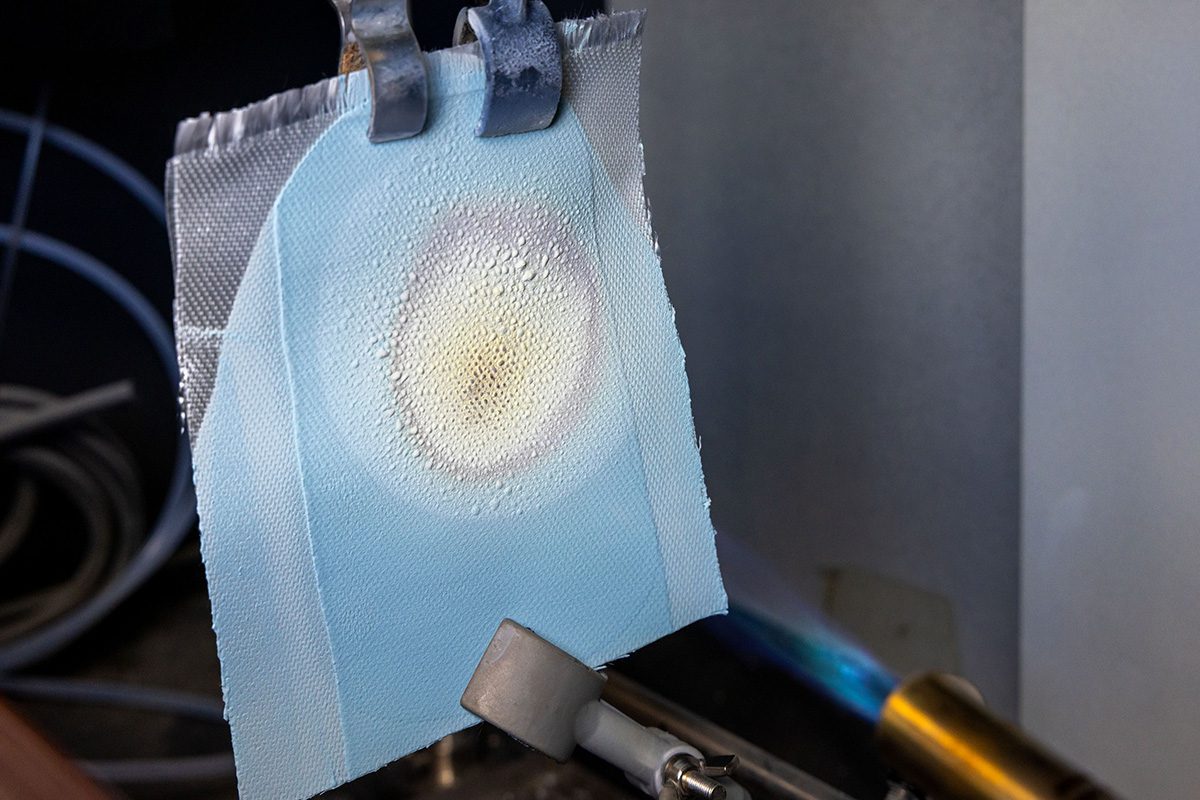
A 1,300°C flame is not representative of average cell core temperature; it is representative of the combustion zone created by electrolyte and vent-gas burning, plus localized metal reactions. This means the material is being tested against a fire exposure scenario, not simply conductive heating from a hot cell.
The fact that the barrier can reduce adjacent radiant exposure below 150°C indicates:
- high thermal resistance,
- low heat flux transmission,
- likely surface emissivity effects,
- and possible barrier thickness/char-layer expansion effects.
However, note that radiative shielding does not guarantee survivability under conductive or convective loading if the barrier is mechanically compromised, perforated, or poorly sealed around penetrations.
Solid-state chemistry: why it is not the primary interpretation
Solid-state cells are often cited in the context of safety, but this article’s language is more consistent with today’s mainstream lithium-ion pack architecture. If this were a solid-state deployment, the thermal barrier requirement would likely shift from “runaway flame containment” toward:
- interface delamination control,
- dendrite suppression at high current density,
- and thermal stress management in brittle ceramic electrolytes.
So the most defensible assumption is conventional Li-ion, likely LFP or NMC, with the material targeted at pack/module safety rather than cell intrinsic chemistry.
Thermal Management Challenges Implied by the Article
Barrier materials do not replace thermal management
The ceramifying silicone is a propagation-control and fire-barrier solution, not a primary heat-removal mechanism. In a well-designed EV pack, thermal management must address three distinct regimes:
- Steady-state cell temperature control during drive and charging
- Transient hot-spot suppression during aggressive fast charging or high-power discharge
- Abuse-event containment during internal short, venting, or runaway
The WACKER material is relevant mostly to regime 3, but the potting compounds affect regime 1 and 2 in support electronics.
Liquid cooling plate design constraints
Cooling plate topology and contact resistance
For battery packs using liquid cooling plates beneath modules or cells, the real performance limiter is often not coolant capacity but thermal contact resistance:
- cell can-to-cooling plate interface,
- gap pad compression behavior,
- module baseplate flatness,
- assembly tolerances,
- and local dry contact zones.
A silicone barrier or potting layer can help or hurt depending on placement. In thermal-path design, silicone is usually a thermal insulator unless heavily filled. The reported potting compounds at 1.6 W/mK and 2.4 W/mK are respectable for electronics potting, but still modest compared with metals, and only suitable where electrical isolation and vibration damping are required.
For battery pack cold plates, typical design considerations include:
- coolant channel pitch vs. pressure drop,
- manifold uniformity,
- local Reynolds number management,
- and mitigation of inlet-to-outlet temperature rise.
Thermal gradients across the cell stack
Even with good liquid cooling, large-format cells can develop:
- axial gradients from tab to mid-span,
- in-plane gradients from face cooling asymmetry,
- and module-to-module gradients from coolant nonuniformity.
These gradients matter because:
- higher temperature accelerates side reactions and SEI thickening,
- lower temperature increases charge-transfer resistance and lithium plating risk,
- and nonuniformity causes cell-to-cell imbalance over life.
A barrier material that only acts after a fault does not solve the continuous problem of maintaining cells within an optimal band, typically near the mid-20s °C depending on chemistry and OEM strategy.
Tab cooling vs. surface cooling
Tab heating is disproportionately important at high C-rate
For pouch and prismatic cells, current enters/exits via tabs or terminal structures, producing localized ohmic heating. At high charge/discharge rates, the electrochemical bottleneck often shifts to the current collector and tab region:
- current crowding near tabs,
- local resistance increase with temperature,
- and thermal concentration at welds or laser-bonded interfaces.
That is why tab cooling can be more effective than pure face cooling in some designs, especially for fast-charging optimization. Surface cooling removes heat spread over the cell envelope, but it may not suppress the peak temperature at the current-collection hotspots.
Surface cooling limitations
Surface cooling relies on heat conduction from active layers to the case/surface. The limitation is the cell’s internal thermal path:
- jelly-roll or stacked-electrode thermal conductivity is low in the through-thickness direction,
- internal heat generation is not spatially uniform,
- and the hottest point during charge may be near tabs, not the geometric center.
So, if the focus is fast charging, a good pack architecture often needs:
- high-conductivity interfaces near tabs,
- distributed cold-plate coupling,
- and careful separation of thermal barriers from normal heat-transfer paths.
Where ceramifying barriers fit
A ceramifying silicone around the boundary region can be very valuable because it:
- preserves compartment integrity during flame impingement,
- prevents ejected particles from reaching adjacent cells,
- and delays thermal coupling after a vent event.
But it can also introduce local thermal bottlenecks if used too broadly near operating cells. In other words, barrier placement must separate:
- abuse-isolation zones from
- steady-state heat-removal zones.
Thermal Runaway Containment Mechanism
Ceramification at high temperature
The key technical feature is the transition from silicone elastomer to a ceramic-like char/structure above roughly 600°C. In practice, this likely provides:
- mass-loss reduction
- intumescent or inorganic residue formation
- lower heat release rate from the barrier itself
- improved flame erosion resistance
- geometric stability under flame impingement
This is important because many polymer systems fail by:
- melting,
- dripping,
- ignition,
- or loss of structural integrity.
A ceramifying silicone avoids catastrophic structural collapse and can maintain a sealing function long enough to satisfy containment requirements.
Radiant heat attenuation
The claim of reducing 1,300°C flame exposure to below 150°C suggests a combination of:
- thermal insulation,
- surface emissivity management,
- thickness-dependent heat flux reduction,
- and possibly char-layer growth that increases thermal path length.
From an engineering standpoint, the meaningful metric is not just temperature but heat flux density at the protected boundary. A material may show a relatively low backside temperature while still transmitting enough energy to damage nearby components if exposure duration is long.
Particle capture during venting
The physical trapping of ejected particles is critical because defective cells can expel:
- hot metal fragments,
- electrode debris,
- separator remnants,
- conductive soot,
- and burning electrolyte droplets.
Particle capture reduces:
- short-circuit ignition of adjacent cells,
- puncture of soft internal barriers,
- and re-ignition risks in confined packs.
This is especially relevant in densely packed modules where line-of-sight propagation paths are short.
Fast-Charging Constraints
Ionic transport bottlenecks
Fast charging is limited by multiple coupled transport phenomena:
- electrolyte ionic conductivity
- solid-state diffusion inside active particles
- charge-transfer kinetics at the electrode/electrolyte interface
- current collector and tab resistance
- thermal rise during charge
When C-rate increases, polarization rises. This pushes local anode potential downward, increasing the risk of metallic lithium deposition if the graphite anode cannot intercalate lithium fast enough.
Lithium plating risk at high C-rates
Why plating happens
Lithium plating is triggered when:
- the anode surface concentration gradient becomes too steep,
- local overpotential becomes strongly negative vs. Li/Li+,
- or temperature is low enough that diffusion and kinetics slow down.
Relevant aggravating factors:
- cold ambient temperature,
- high SOC,
- aged cells with higher impedance,
- uneven current distribution,
- and insufficient tab/cell cooling.
Why thermal management affects plating
A paradox exists:
- higher temperature improves ionic conductivity and charge transfer,
- but excessive temperature accelerates side reactions and aging.
So the ideal charge window is narrow. If thermal gradients are large, some regions of the cell may be warm enough to accept charge while others remain cold enough to plate lithium. That nonuniformity is a hidden failure mode in large-format systems.
Chemistries and plating sensitivity
- NMC/NCA graphite systems are generally more plating-sensitive under aggressive fast charging.
- LFP graphite systems still plate under high current or low temperature, even if they are more thermally stable in runaway.
- If silicon-rich anodes are used, fast-charge behavior becomes even more complex due to expansion, cracking, and higher impedance growth.
Thus, any pack-level barrier strategy must coexist with an active thermal strategy that keeps charging temperature uniform and sufficiently high for safe lithium intercalation, but not so high that it accelerates calendar and cycle aging.
Interpretation of the Potting Compounds
Thermal conductivity values are application-specific, not pack-level cooling solutions
The RT 7616 TC and RT 7624 TC materials at 1.6 W/mK and 2.4 W/mK are suitable for:
- power inductors,
- DC/DC converters,
- charger electronics,
- inverter auxiliaries,
- and vibration-sensitive discrete components.
These are not equivalent to structural battery thermal interface materials optimized for direct cell-to-cold-plate heat extraction. Their role is typically:
- dielectric isolation,
- mechanical damping,
- environmental sealing,
- and moderate heat spreading.
Sedimentation control matters in manufacturing
The stated resistance to filler sedimentation is significant because thermally conductive silicones often rely on a heavy filler fraction. If fillers settle:
- top/bottom thermal conductivity becomes nonuniform,
- viscosity drifts,
- dispensing becomes inconsistent,
- and cured thermal performance varies device-to-device.
For automotive qualification, that variability matters for:
- long shelf life,
- transport vibration,
- and production-line repeatability.
System-Level Engineering Assessment
What the article actually indicates about EV safety design
The technology described points toward a broader industry trend:
- abuse mitigation is becoming material-science-driven
- thermal containment is being designed as a layered defense
- packs increasingly require fire barrier systems that withstand both radiant and particulate threats
- electronics thermal management is converging with encapsulation and dielectric protection
In practice, an EV battery pack must be optimized across three competing priorities:
- low impedance heat removal,
- high-abuse containment,
- long-term manufacturability and serviceability.
Ceramifying silicone is attractive because it can bridge the gap between flexible assembly and high-temperature survival, but it must be deployed carefully to avoid compromising normal operation thermal paths.
Design trade-offs
Key trade-offs for engineers:
- More barrier material improves propagation resistance but may worsen weight, packaging, and thermal resistance.
- Higher thermal conductivity potting improves auxiliary electronics cooling but can increase stiffness and complicate rework.
- Aggressive fast-charge thermal setpoints improve charging time but magnify lithium plating risk and cell-to-cell nonuniformity.
- Cooling plate uniformity reduces gradients but increases hydraulic complexity and cost.
Bottom-Line Engineering View
From an engineering standpoint, the article describes a containment-oriented materials solution, not a breakthrough in cell electrochemistry. Its main value is in post-fault thermal isolation and pack/electronics thermal reliability.
The most likely cell context is conventional lithium-ion, probably LFP or NMC, where:
- LFP offers better thermal robustness but lower energy density,
- NMC/NCA offers higher energy density but more severe runaway and propagation risk.
The barrier technology addresses the abuse envelope created by thermal runaway, while fast-charging performance still depends on:
- ionic transport,
- current distribution,
- thermal uniformity,
- and lithium plating avoidance.
In short: this is a pack-safety and thermal-management materials story, not a chemistry revolution.