Core Technology: SiOC Spherical Anode Architecture
The article describes a silicon oxycarbide (SiOC) spherical anode, positioned as a higher-capacity alternative to graphite for EV lithium-ion batteries. From an engineering standpoint, this is not “pure silicon anode” technology; it is a ceramic-derived composite anode material with a fundamentally different failure envelope.
SiOC is typically produced from a pre-ceramic polymer precursor that undergoes pyrolysis to form a mixed amorphous Si–O–C network, often with embedded free carbon phase and residual nanostructural heterogeneity. The key value proposition is a compromise between:
- Graphite’s excellent cyclability and low swelling
- Silicon’s very high specific capacity but severe volumetric expansion
- Ceramic phase stability that suppresses pulverization and interfacial instability
The article’s claims imply an anode designed for high reversible lithium storage, low parasitic surface reactivity, and mechanically constrained lithiation via spherical particle engineering.
1) Assumed Cell Chemistry and Intrinsic Limitations
Most Likely Cathode Pairing
Because the article is focused on an anode material, the full cell chemistry is not explicitly stated. In EV applications, a SiOC anode would most likely be paired with one of the following:
- LFP (LiFePO₄) for cost, safety, and long cycle life
- High-nickel NMC (e.g., NMC 622/811) for higher energy density
- Less likely: LMFP or high-voltage spinel variants
If the material is intended for mainstream EV deployment, LFP pairing is the most forgiving electrically and thermally, while NMC pairing is the more energy-dense but more stress-sensitive architecture.
If Paired with LFP
An LFP/SiOC cell would likely be constrained by:
- Moderate cell-level energy density
- Lower thermal runaway propensity
- Excellent cycle life potential if anode swelling is controlled
- Potentially better fast-charge tolerance than NMC systems, but still anode-limited
Intrinsic limitations remain:
- LFP has lower cathode potential window utilization than NMC.
- The cell’s overall energy density is still heavily dependent on the anode’s initial coulombic efficiency (ICE) and first-cycle lithium loss.
- SiOC, like other silicon-containing anodes, typically consumes significant lithium in SEI formation. If ICE is poor, the practical full-cell gain over graphite is reduced.
If Paired with NMC
For NMC/SiOC, the main issue is not just energy density but system-level durability under aggressive operating profiles:
- NMC has higher thermal sensitivity and tighter allowable thermal gradients.
- High-voltage operation accelerates:
- electrolyte oxidation
- cathode surface reconstruction
- transition-metal dissolution
- SEI/CEI cross-talk
SiOC may improve gravimetric capacity, but the full cell still inherits NMC’s:
- oxygen release risk at elevated states of charge
- sensitivity to pack-level temperature nonuniformity
- accelerated aging under high C-rate charge/discharge
Intrinsic Limitations of SiOC Itself
Even assuming superior engineering relative to graphite, SiOC remains constrained by the following material limits:
1. First-Cycle Irreversible Capacity Loss
SiOC is expected to form a substantial SEI due to unavoidable electrolyte decomposition on its surface. Even with spherical morphology and lower surface area, the material will still consume lithium during formation. This impacts:
- initial coulombic efficiency
- formation protocol aggressiveness
- lithium inventory balance in full cells
2. Lower Electronic Conductivity Than Graphite
SiOC typically relies on a conductive carbon scaffold or composite architecture. Pure SiOC is not naturally as electronically favorable as graphite, so electrode design must compensate with:
- carbon coating
- conductive additive network optimization
- porosity control
- calendering strategy tuned to preserve conduction pathways
3. Anode Potential Shift and Plating Risk
Compared with graphite, silicon-containing anodes can have more complex lithiation kinetics and local overpotential distribution. If the anode is not uniformly accessible, local regions may still polarize below 0 V vs. Li/Li⁺ during charging, creating lithium plating susceptibility at high current.
4. Volume Stability Is Improved, Not Eliminated
The article’s <8% swelling target is excellent compared with silicon metal, but the relevant engineering question is not only average swelling. It is:
- particle-to-particle expansion mismatch
- electrode-level stress accumulation
- binder fatigue
- current collector adhesion loss
- impedance rise from contact degradation
So, despite the ceramic backbone, the electrode still requires a mechanical compliance strategy.
2) Thermal Management Challenges
Why SiOC Changes the Thermal Problem, But Does Not Solve It
Higher-capacity anodes increase:
- areal energy density
- heat generation during high-rate charge
- sensitivity to local temperature nonuniformity
The thermal management challenge is not simply average pack temperature. It is spatial thermal gradients inside the cell, especially during fast charge, when local heat flux is highly nonuniform.
Heat Generation Mechanisms
Heat in an EV cell is generated by:
- Ohmic heating: ( I^2R )
- Reaction overpotential heating
- Entropy heating/cooling from electrochemical reactions
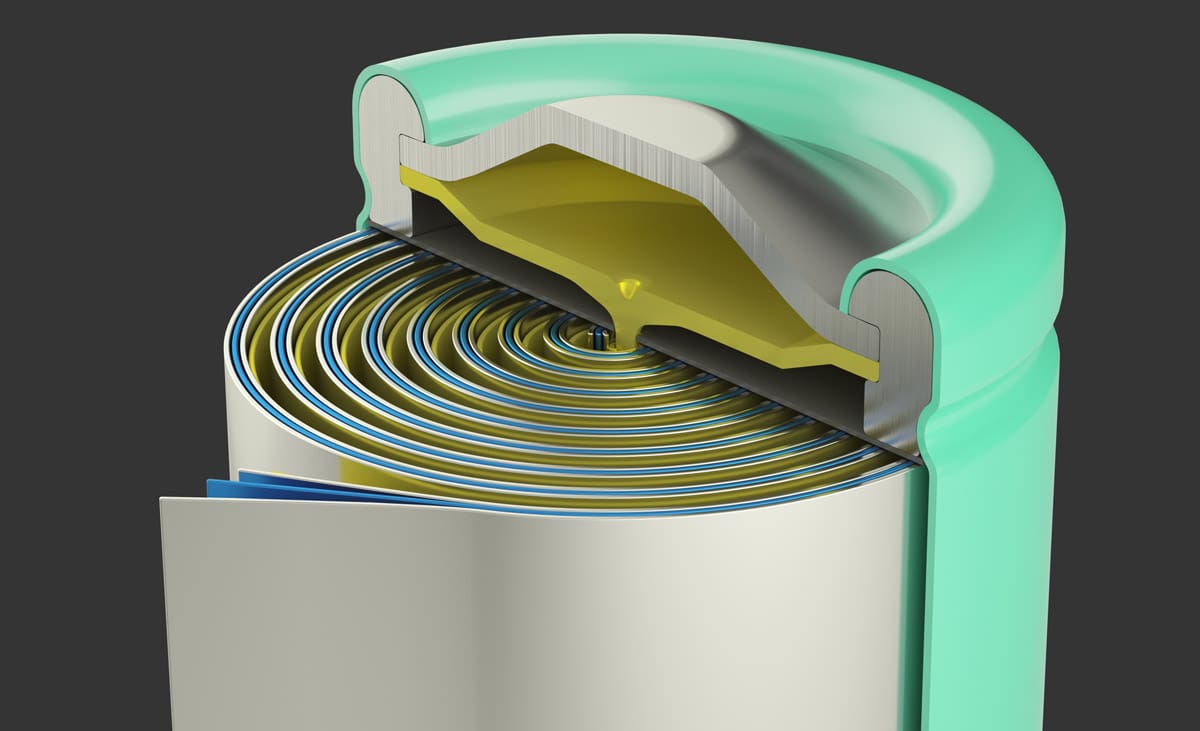
- Localized heat at current collector, tab, and jellyroll interfaces
In a SiOC anode cell, heat generation can be amplified by:
- higher impedance if the electrode is insufficiently conductive
- SEI growth-driven resistance increase
- high lithiation rates causing concentration polarization
Liquid Cooling Plate Design Considerations
If this anode is used in a high-energy EV cell, the pack will likely require liquid-cooled modules. The cooling plate design becomes critical.
Key design constraints:
-
Thermal contact resistance
- cell-to-tube / cell-to-plate interface conductivity must be minimized
- module compression must be uniform to prevent mechanical damage while ensuring contact
-
Coolant channel layout
- serpentine channels improve coverage but can create coolant temperature rise along flow direction
- parallel channels reduce gradient but increase manifold complexity and flow balancing challenges
-
Heat flux nonuniformity
- edge cells and tab-adjacent cells can be hotter than center cells
- if tab heating is not addressed, the plate alone cannot eliminate hot spots
- Pressure drop vs. thermal uniformity
- a more aggressive channel geometry improves heat transfer but raises pumping losses
- system-level optimization must balance parasitic energy consumption against thermal margin
Thermal Gradients: The Hidden Degradation Driver
Even if average pack temperature is acceptable, through-thickness and in-plane gradients can create a major reliability problem:
- Higher-temperature regions age faster due to accelerated SEI kinetics
- Cooler regions have higher charge-transfer resistance, causing local polarization
- This self-reinforces nonuniform current distribution
For a SiOC anode, gradients are especially important because:
- lithium insertion kinetics are sensitive to local temperature
- nonuniform lithiation can create stress concentration
- repeated differential expansion can lead to microcracking or conductive network loss
Tab Cooling vs. Surface Cooling
This is one of the most critical engineering distinctions.
Surface Cooling
Surface cooling is effective for extracting average heat from pouch or prismatic cells, but it may not adequately remove hot spots near the current collectors.
Pros:
- simpler implementation
- good for bulk temperature control
- compatible with module-level cooling plates
Cons:
- poor at removing localized tab and end-region heat
- thermal path length may be too large for high C-rate operation
- can leave internal hot spots undetected until aging accelerates
Tab Cooling
Tab cooling targets the high-current region directly. For fast-charging cells, this can be significant because tabs are often one of the dominant resistive heating sites.
Pros:
- directly addresses localized current concentration
- reduces peak temperature at the electrical connection point
- helps suppress current inhomogeneity in large-format cells
Cons:
- mechanically and electrically more complex
- sealing, packaging, and insulation are more difficult
- integration with liquid cooling is more challenging
Practical Assessment
If X-BATT’s SiOC anode truly supports high-rate charging, the cell architecture still needs:
- low-resistance tab design
- highly uniform stack/jellyroll current distribution
- cooling path tuning for tab-adjacent hot spots
- thermally conductive interface materials with controlled compression behavior
Without these, the anode’s intrinsic merits will be masked by thermal nonuniformity.
3) Fast-Charging Constraints
The 8C Claim Must Be Evaluated at the Electrode Physics Level
An >8C charge target is extremely aggressive for an EV anode. Even if the anode material can theoretically accommodate lithium, the full cell fast-charge performance will be limited by:
- ionic transport through electrolyte and porous electrode
- charge transfer kinetics at the interface
- solid-state lithium diffusion within the active particle
- local overpotential and plating threshold
- thermal buildup during charge
Ionic Conductivity and Transport Limits
At high C-rates, the electrolyte must deliver lithium ions rapidly enough to avoid concentration depletion near the anode surface.
Key bottlenecks:
- separators and electrolyte salt concentration
- pore tortuosity in the electrode
- pore wetting quality
- ionic conductivity loss at low temperature
- diffusion-limited salt depletion near the SEI
If the anode uses tightly packed spherical SiOC particles with low surface area, that can help reduce parasitic reactions, but it can also reduce active interfacial area if not carefully engineered. The result is a tradeoff between:
- lower side reactions
- higher local current density
Lithium Plating Risk
At high charge rates, the most critical failure mode is lithium plating on the anode surface.
This occurs when:
- the anode potential drops too close to or below 0 V vs. Li/Li⁺
- lithium insertion kinetics cannot keep up with the applied current
- local concentration polarization becomes severe
- cold conditions further suppress diffusion and interfacial kinetics
Why SiOC Still Faces Plating Risk
Even though SiOC can store more lithium than graphite, its fast-charge behavior depends on:
- particle microstructure
- effective diffusion length
- electrolyte access
- SEI stability
- electrode density and porosity
A high-capacity anode does not automatically mean a high-power anode. If diffusion pathways are long or the interface is resistive, the cell can still plate lithium before fully utilizing the anode capacity.
The Role of Particle Morphology
The article emphasizes:
- near-perfect microspheres
- tight size distribution
- low surface area
These features are beneficial for:
- packing density consistency
- controlled porosity
- predictable calendering response
- reduced surface reactivity
But they also impose tradeoffs:
- too low a surface area can reduce charge acceptance
- too high a density can hinder electrolyte penetration
- overly smooth or uniform particles may reduce mechanical anchoring in the binder matrix unless surface treatment is optimized
Fast-Charge Window in an EV Context
From a battery engineering perspective, sustained 8C charging is only plausible if several conditions are met simultaneously:
- high electrolyte ionic conductivity
- optimized electrode thickness
- low tortuosity pore network
- excellent thermal control
- tightly managed charge protocol with thermal derating
- strong formation process to stabilize SEI
- possibly elevated charging temperature to suppress plating, while still staying below aging thresholds
Real-world constraints will almost certainly force dynamic control based on:
- cell temperature
- state of charge
- internal resistance growth
- cell balancing status
- pack-level coolant availability
4) Engineering Interpretation of the SiOC Value Proposition
What the Material Actually Solves
SiOC appears to address three major graphite limitations:
- Capacity ceiling
- graphite is fundamentally limited to ~372 mAh/g theoretical
- Swelling control
- ceramic-derived matrix improves dimensional stability relative to silicon metal
- Surface reactivity
- spherical morphology and low surface area reduce decomposition pathways
What It Does Not Solve
It does not eliminate:
- SEI formation losses
- fast-charge thermal excursions
- full-cell lithium inventory management
- pack-level cooling requirements
- cathode-driven constraints if paired with NMC
- system-level lithium plating under cold/high-current operation
5) Teardown-Level Assessment: What Would Need Validation
From a battery teardown and validation perspective, the article’s targets would need confirmation through:
- half-cell and full-cell ICE measurement
- dV/dQ analysis for lithium inventory losses
- EIS before/after formation and cycling
- X-ray CT for swelling and particle integrity
- post-mortem SEM of SEI morphology
- cross-section analysis for electrode delamination
- accelerated fast-charge cycling at low and room temperature
- calorimetry to quantify heat generation under >4C and >8C regimes
Critical questions:
- Does the claimed >8,000-cycle life hold at meaningful depth of discharge and realistic EV thermal conditions?
- Is the swelling figure measured at particle level, electrode level, or constrained cell level?
- Is the 8C rate a pulse spec, a partial charge window, or a full charge metric?
- How much lithium is irreversibly consumed in formation?
Conclusion
The reported X-BATT SiOC spherical anode is best interpreted as a structured ceramic-derived lithium-storage anode intended to bridge the gap between graphite stability and silicon-class capacity. Its engineering value depends less on headline capacity and more on whether it can preserve:
- low impedance under high C-rate charging
- mechanical integrity under repeated expansion-contraction
- stable SEI with limited lithium inventory loss
- manufacturable electrode density and calendering behavior
From a systems standpoint, the material still faces the same fundamental EV battery constraints:
- chemistry coupling limits from LFP or NMC pairing
- thermal management requirements driven by localized heat and gradient control
- fast-charge risk of lithium plating if transport and temperature are not tightly controlled
In short, SiOC may improve the anode side of the equation, but the EV battery remains a coupled electrochemical-thermal-mechanical system. The success criterion is not anode capacity alone; it is whether the full cell architecture can sustain those targets without unacceptable impedance growth, plating, or thermal nonuniformity.