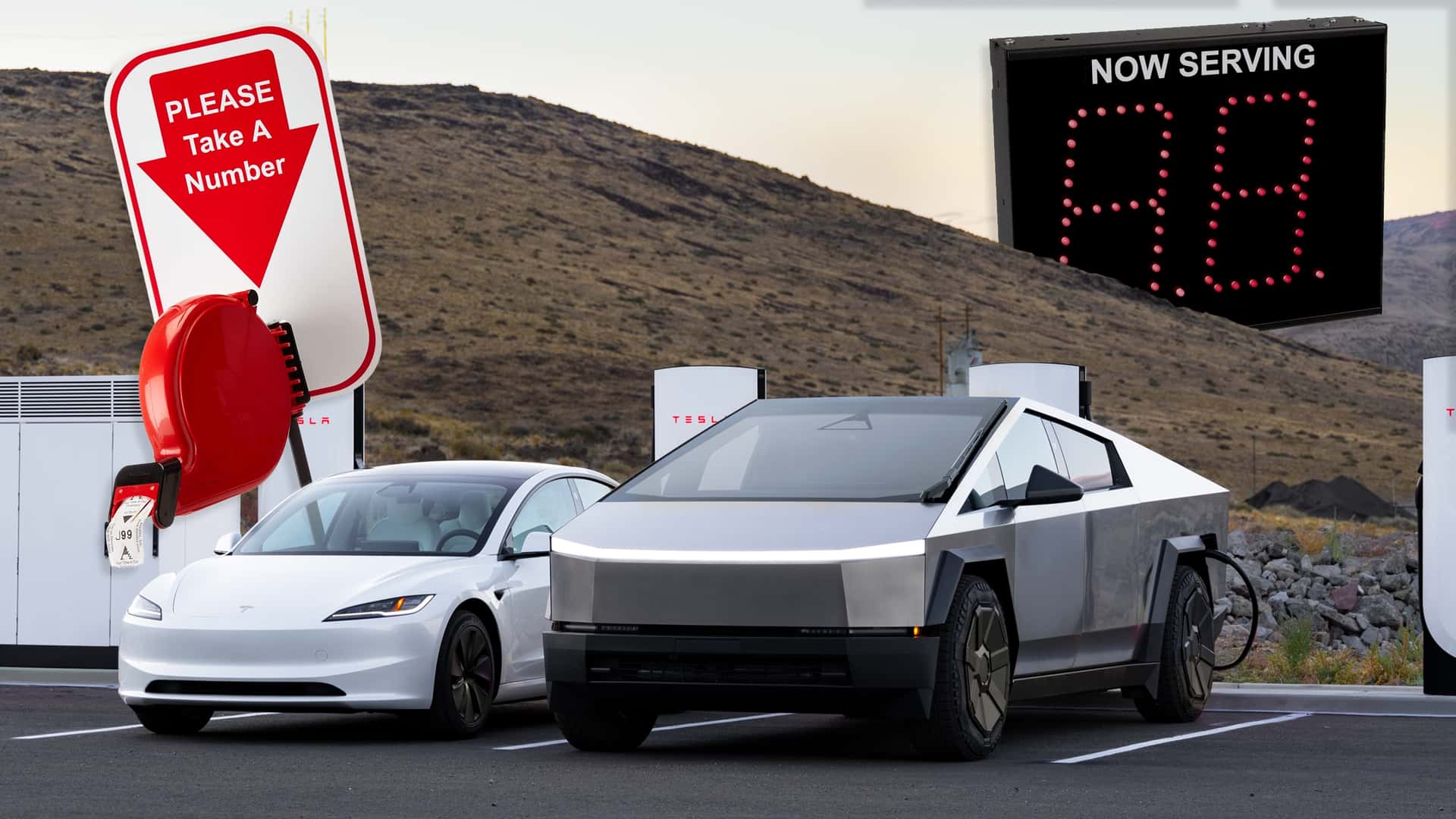
Virtual Queueing Is a Software Fix for a Physical Bottleneck
Tesla’s pilot of a virtual Supercharger waitlist addresses a real operational problem: DC fast charging demand is increasingly uneven, and physical queueing creates inefficiency, conflict, and idle energy consumption. But the underlying challenge is still electrochemical. As charging power rises, especially for LFP battery packs optimized for safety, cycle life, and cost, the limiting factors shift from infrastructure convenience to cell-level heat generation, ionic transport, and mechanical durability.
A better queue system reduces frustration. It does not reduce the fundamental stresses imposed by extreme-rate charging.
Why High-Power Charging Is Hard for LFP Batteries
LFP chemistry is attractive for fast-charging EVs because it offers strong thermal stability, long cycle life, and lower material cost than nickel-rich chemistries. However, LFP is not immune to fast-charge limitations. The cathode itself is relatively robust, but the real bottleneck usually lies in the anode, electrolyte, and internal transport kinetics.
Ionic conductivity and polarization losses
At high charge rates, lithium ions must move rapidly through:
- the bulk electrolyte,
- porous electrode tortuosity,
- the separator,
- solid-state diffusion pathways inside active particles.
If any of these transport steps becomes rate-limiting, the cell develops polarization. That means the charger may be supplying current quickly, but the electrochemical interfaces cannot accept lithium ions at the same pace.
Key consequences include:
- higher overpotential at the graphite anode,
- localized current density peaks,
- increased ohmic and charge-transfer heat,
- reduced effective state-of-charge accuracy during charging.
For LFP packs, the flat voltage plateau makes charge estimation more challenging under dynamic thermal and current conditions. At high power, voltage rise may reflect polarization more than actual stored energy, complicating BMS control.
Heat Generation at Extreme Charging Rates
Fast charging converts a larger fraction of input power into heat. This heat is generated through three main mechanisms:
- Joule heating: ( I^2R ) losses in tabs, busbars, current collectors, electrolyte, and contact interfaces.
- Reaction heat: entropic and kinetic heat at the electrode/electrolyte interfaces.
- Non-uniform heating: hotspot formation from uneven current distribution and local impedance differences.
At very high C-rates, thermal gradients can develop across the cell stack and across the pack. These gradients matter because lithium-ion cells are highly sensitive to temperature non-uniformity. A few degrees of difference can alter local reaction kinetics, aggravate aging, and increase the risk of lithium plating.
Why thermal gradients are dangerous
Uneven temperature creates uneven charge acceptance. Warmer regions charge faster; cooler regions charge slower and can become plating-prone. This is especially problematic in large-format LFP packs where:
- long current paths increase resistive losses,
- cell-to-cell dispersion is amplified,
- edge cells may cool differently from inner cells,
- pack-level coolant distribution becomes critical.
How Thermal Management Systems Handle Fast-Charge Heat
Modern EV packs depend on aggressive thermal management to survive repeated DC fast charging. The goal is not merely to keep cells “cool,” but to keep them in a narrow temperature band with minimal spatial variation.
Liquid cooling plates as the primary heat rejection path
Liquid cooling plates are the backbone of high-power pack thermal management. They are typically integrated beneath or between modules and use a water-glycol loop to extract heat from the cell assembly.
Their benefits include:
- high heat transfer coefficient,
- good scalability for large packs,
- compatibility with preconditioning before charging,
- ability to spread heat laterally, not just remove it vertically.
For LFP packs undergoing fast charging, liquid cooling plates must do more than limit peak temperature. They must also reduce temperature deltas across the module. If one side of a module is 8–10°C hotter than the other, charging current distribution becomes uneven and localized aging accelerates.
Thermal design priorities during fast charging
An effective system typically manages:
- inlet coolant temperature,
- flow distribution uniformity,
- plate-channel geometry,
- thermal interface material performance,
- module compression and contact integrity,
- pack preconditioning strategy.
The best systems use predictive control. If a vehicle navigation system knows the charger destination in advance, it can precondition the pack so that the battery arrives at an optimal temperature window. That is especially valuable for LFP, which often charges best when warm enough to support ion mobility, but not so hot that degradation accelerates.
Lithium Plating Risk Remains the Core Electrochemical Constraint
Even with excellent cooling, fast charging can still trigger lithium plating on the graphite anode. This is one of the most important failure modes in high-rate charging.
Why plating occurs
Lithium plating happens when the anode potential drops too low during charging, causing lithium ions to deposit as metallic lithium instead of intercalating into graphite. It becomes more likely when:
- charging current is too high,
- cell temperature is too low,
- anode diffusion is too slow,
- SOC is already high,
- the cell has aged and impedance has increased.
For LFP packs, the cathode is not usually the limiting factor; the graphite anode and electrolyte transport are. At low temperatures, LFP vehicles are especially vulnerable because the chemistry may be thermally stable, but the anode kinetics are sluggish.
Consequences of plating
Lithium plating can lead to:
- irreversible capacity loss,
- increased impedance,
- dendrite formation,
- internal short risk,
- accelerated calendar and cycle aging.
Repeated mild plating may not cause immediate failure, but it slowly erodes usable capacity and charging performance. In fleet or high-utilization vehicles, this can become a major warranty and residual-value issue.
Structural Integrity Under Repeated High-Rate Cycling
Fast charging does not only stress electrochemistry. It also stresses mechanics.
Sources of mechanical degradation
During rapid charge/discharge events, cells experience:
- electrode swelling and contraction,
- binder fatigue,
- separator stress,
- tab and weld fatigue,
- compression relaxation in the module stack.
In LFP cells, volumetric changes are generally more manageable than in some higher-energy chemistries, but repetitive high-rate cycling still induces structural wear. Localized heating can worsen this by creating expansion mismatch between adjacent components.
Module and pack-level concerns
At the pack level, structural integrity depends on:
- consistent clamp force,
- robust weld and interconnect design,
- low-resistance current paths,
- vibration tolerance,
- coolant-induced material compatibility.
If fast charging is frequent, thermal cycling can degrade adhesives, sealants, and interfacial pads. Over time, reduced compression increases contact resistance, which then increases heat generation—a self-reinforcing failure loop.
Implications for Future Fast-Charging Infrastructure
Tesla’s virtual queue is a useful operational layer, but the next bottleneck is not line management. It is the ability of battery systems to accept high current repeatedly without damage.
To support faster charging sustainably, systems need:
- better pack preconditioning,
- more uniform liquid cooling plate designs,
- lower-resistance cell and busbar architectures,
- refined BMS algorithms for plating avoidance,
- improved diagnostic models for real-time impedance tracking,
- tighter control of coolant flow and thermal gradients.
For LFP battery platforms, the opportunity is significant: they can be fast-charged more safely than many chemistries, but only if thermal management and charge control are engineered around their ionic transport limits. The pack must be treated as an electro-thermal-mechanical system, not just an energy container.
Bottom Line
The virtual waitlist improves the user experience at the charger, but the real technical race is inside the pack. High-rate charging pushes LFP batteries toward the edge of ionic conductivity limits, increases localized heat generation, and raises the risk of lithium plating and mechanical fatigue. Liquid cooling plates and advanced thermal control can keep temperatures in check, but they cannot fully eliminate the electrochemical constraints.
Fast charging will continue to scale only when infrastructure intelligence and battery thermal engineering advance together.
Source reference: Industry News