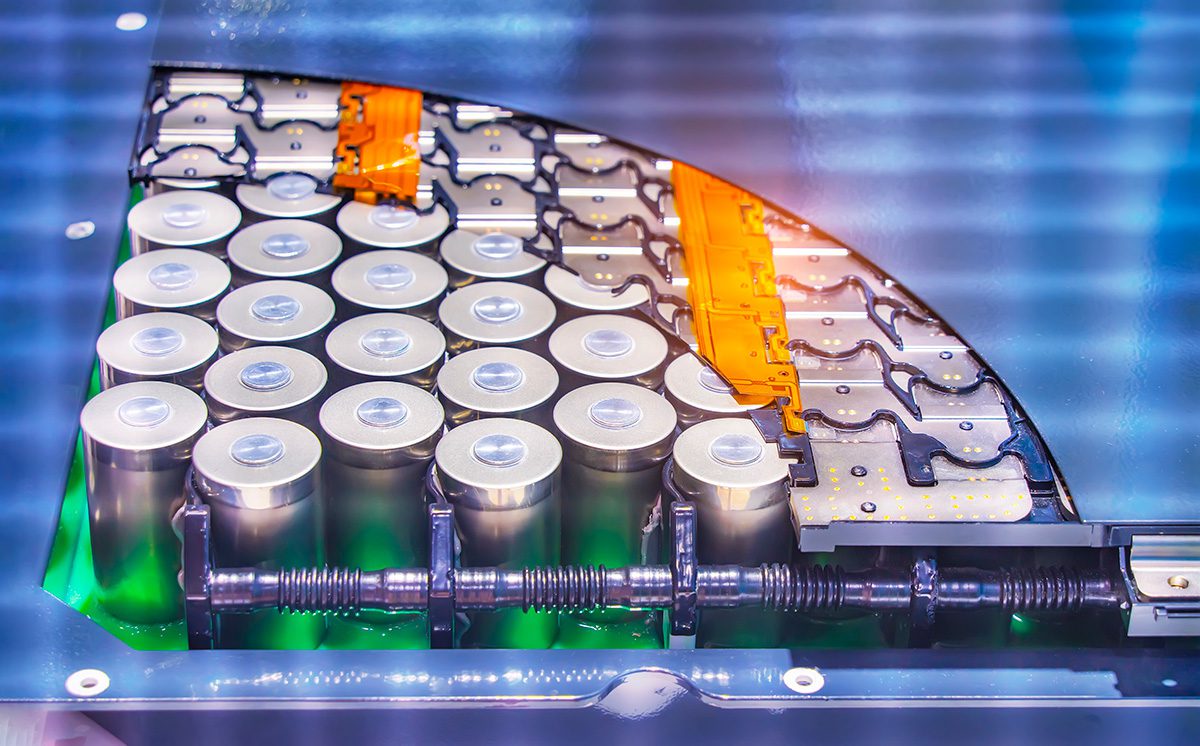
Core Technology Context
The article is not primarily about electrochemistry; it is about cell-contact architecture for battery packs, specifically the transition from discrete wiring harnesses to flexible printed circuits (FPCs) used as cell tapping / sensing interconnects in BMS-integrated battery modules.
From an engineering standpoint, the underlying technology issue is this:
- As pack energy density increases, cell-level voltage and temperature observability becomes more important.
- Traditional wire harnesses introduce:
- higher assembly labor,
- routing variability,
- larger tolerance stack-up,
- higher connector count,
- increased failure probability under vibration and thermal cycling.
- FPC-based cell contact systems reduce mass, simplify routing, and improve channel density for measurement lines.
The article does not specify cell chemistry, but the system-level design constraints strongly suggest a high-energy-density EV lithium-ion pack, most plausibly NMC/NCA-class cells, with LFP also feasible in cost-focused variants. The engineering implications differ substantially by chemistry.
1) Assumed Cell Chemistry and Intrinsic Limitations
Likely chemistry: NMC or NCA, with LFP as a secondary possibility
The language used around “increased battery density” and the need to maximize usable energy while maintaining safety is most consistent with nickel-rich lithium-ion chemistries such as:
- NMC (LiNiMnCoO₂)
- NCA (LiNiCoAlO₂)
These chemistries are commonly selected where gravimetric and volumetric energy density are the primary goals. LFP is less likely if the marketing emphasis is on “pushing the envelope” in energy density, although it remains relevant in cost-optimized platforms.
Intrinsic limitations of NMC/NCA
Nickel-rich layered oxides provide high specific capacity, but they impose a set of nontrivial constraints:
Thermal instability
- The cathode lattice becomes less stable at elevated state of charge (SOC).
- Oxygen release risk increases under abuse, overcharge, or localized overheating.
- Exothermic side reactions can self-accelerate once temperatures rise beyond safe operating envelopes.
Higher sensitivity to imbalance
- Small cell-to-cell voltage errors can cause overcharge of the highest cell in a series string.
- Because usable voltage windows are tightly managed, measurement accuracy is critical.
- This is exactly where low-noise, high-integrity cell tapping becomes important.
Calendar and cycle aging
- Nickel-rich cells suffer from:
- SEI growth,
- electrolyte oxidation at high voltage,
- transition metal dissolution,
- microcrack formation in secondary particles.
- These mechanisms are accelerated by thermal gradients and poor balancing visibility.
Intrinsic limitations of LFP, if that chemistry is used
If the pack is LFP-based, the design problem changes rather than disappears:
Lower energy density
- LFP’s olivine structure is intrinsically safer and more stable, but it trades away energy density.
- More cells and more interconnects are needed for equivalent pack energy, which increases:
- assembly complexity,
- contact count,
- monitoring channels,
- system footprint.
Flat OCV-SOC curve
- LFP has a very flat open-circuit voltage profile across much of the usable SOC window.
- This makes SOC estimation more difficult:
- small measurement errors translate to large SOC uncertainty,
- voltage-based diagnostics are less informative,
- temperature-compensated estimation becomes essential.
Low-temperature power limitation
- LFP suffers from reduced low-temperature kinetics.
- Fast charge acceptance drops sharply in cold conditions due to increased polarization and lithium diffusion limitations.
Why FPC-based cell contact systems matter regardless of chemistry
Regardless of whether the chemistry is NMC or LFP, the pack architecture increasingly depends on high-fidelity cell telemetry. Cell-contact systems must deliver:
- low-resistance voltage sense paths,
- stable impedance over life,
- vibration resistance,
- thermal cycling durability,
- manufacturability at scale.
An FPC simplifies routing of multiple cell taps while reducing harness mass and improving repeatability of assembly geometry.
2) Theoretical Thermal Management Challenges
The article mentions temperature monitoring, but the deeper engineering issue is that measurement alone does not solve thermal nonuniformity. In modern high-density packs, thermal management must be co-designed with sensor placement and interconnect architecture.
Cooling architecture constraints in high-density packs
Liquid cooling plate design
Most EV packs using high-energy lithium-ion cells rely on liquid cooling plates, typically located:
- beneath prismatic or pouch cells,
- between cell rows,
- or integrated as a cold plate/manifold structure.
Key design tradeoffs include:
Channel geometry
- Serpentine channels improve heat removal but increase pressure drop.
- Parallel channels reduce hydraulic loss but risk maldistribution.
- Pin-fin or microchannel designs improve local heat transfer but may increase clogging sensitivity and manufacturing complexity.
Contact resistance to the cell can
For prismatic and pouch cells, the thermal path often includes:
- cell jelly roll/core,
- can or pouch wall,
- TIM or pad,
- cooling plate surface.
The effective thermal resistance is strongly influenced by:
- surface flatness,
- contact pressure,
- TIM aging,
- compression set,
- local warpage of the cell can.
Module-level thermal gradients
Even with liquid cooling, gradients remain unavoidable because heat generation is not uniform:
- current distribution is non-uniform,
- tab regions run hotter,
- edge cells often have different boundary conditions than center cells,
- manifold-fed coolant temperatures rise along flow direction.
This creates axial, transverse, and through-thickness gradients, which directly affect:
- cell balance,
- aging dispersion,
- and local safety margin.
Temperature sensing via FPC: benefits and limitations
FPC-based sensing provides better packaging density than discrete wires, but it also imposes engineering constraints.
Benefits
- Highly repeatable routing geometry
- Lower mass and reduced part count
- Better scalability to large channel counts
- Improved assembly automation
- Reduced connector proliferation
Limitations
- Copper trace thickness limits current carrying capability, though for sensing circuits this is usually acceptable.
- Adhesive and substrate creep under heat can alter sensor positioning.
- Sensor-to-cell coupling becomes more difficult if the FPC lifts off or is poorly constrained.
- Calibration must account for local thermal lag between cell surface and measurement point.
Tab cooling vs. surface cooling
A critical but often underappreciated issue is where heat is extracted.
Surface cooling
This is common for pouch and prismatic batteries where a plate or pad cools the broad face of the cell.
Advantages:
- larger heat transfer area,
- simpler mechanical implementation,
- lower hotspot severity if contact is uniform.
Disadvantages:
- heat must conduct through the cell body to reach the cold surface,
- internal core temperatures can remain significantly higher than surface readings suggest,
- thermal gradients can be large under fast charge/discharge.
Tab cooling
Tab cooling is attractive because current collection points are often also thermal bottlenecks.
Advantages:
- directly addresses one of the hottest regions,
- can reduce localized resistance heating,
- potentially lowers peak tab temperature under high current.
Disadvantages:
- tabs are mechanically delicate and difficult to cool uniformly,
- tab-to-busbar interfaces are often constrained by welding geometry and contact resistance,
- differential thermal expansion can fatigue welds or laminate transitions.
Engineering implication
In practice, surface cooling and tab cooling should not be viewed as mutually exclusive. High-power packs increasingly require a hybrid thermal strategy:
- broad-area cooling for average temperature control,
- localized tab/busbar thermal management for hotspot suppression.
This is especially important when the sensing network is FPC-based: the telemetry may detect overtemperature, but only an effective thermal extraction path prevents the temperature excursion from becoming a life-limiting event.
Thermal gradient impact on aging and reliability
Nonuniform temperature produces strongly nonlinear aging behavior:
- A 5–10 °C local hotspot can dramatically accelerate:
- electrolyte decomposition,
- SEI thickening,
- gas generation,
- impedance rise.
- Higher resistance cells then self-heat more under load, creating a positive feedback loop.
- Monitoring precision is therefore only useful if the thermal design can prevent persistent gradients.
3) Fast-Charging Constraints
The article implicitly connects data quality to safe energy-density maximization, which in practice includes fast-charge capability. Fast charging is not governed by a single limit but by coupled electrochemical and thermal constraints.
Ionic conductivity limits
At elevated C-rates, the rate-limiting processes include:
- lithium-ion diffusion in the electrolyte,
- transport through separator pores,
- solid-state diffusion within active particles,
- charge transfer kinetics at electrode interfaces.
Electrolyte transport
The electrolyte must support sufficient ionic conductivity to avoid large ohmic losses. If not:
- concentration polarization increases,
- local overpotential rises,
- cell voltage may hit upper cutoffs before the cell is fully charged.
Solid-state diffusion
Even if the electrolyte is adequate, lithium must intercalate into the active material. At high charge rate:
- the surface concentration can rise faster than bulk diffusion can equilibrate,
- steep concentration gradients form inside particles,
- particle cracking and stress can increase.
Lithium plating risk
Fast charging at low temperature, high SOC, or excessive current density can trigger metallic lithium plating on the graphite anode.
Mechanism
When the anode potential drops near 0 V vs. Li/Li⁺:
- Li⁺ can no longer intercalate quickly enough,
- metallic lithium deposits on the surface instead,
- plated lithium may later become electrically isolated as “dead lithium”.
Consequences
- irreversible capacity loss,
- increased impedance,
- gas generation,
- dendritic growth risk,
- accelerated aging and safety degradation.
Conditions that increase plating probability
- low cell temperature,
- high initial SOC,
- high charge current,
- high internal resistance,
- nonuniform current distribution,
- inadequate thermal preconditioning.
Why improved cell contact sensing is relevant to fast charge
FPC-based cell contact systems do not directly solve plating, but they enable better control by improving observability:
- accurate per-cell voltage channels reduce overcharge risk,
- temperature sensing supports charge derating,
- better data allows model-based charge controllers to apply dynamic current limits,
- early detection of imbalance can prevent the most vulnerable cell from entering plating-prone conditions.
System-level constraint: measurement fidelity vs. electrochemical response
A key engineering limitation is that battery safety control is only as good as the temporal and spatial resolution of the sensing network.
- If voltage sensing is noisy or delayed, the BMS may overestimate charge acceptance.
- If temperature sensors are poorly coupled, surface temperature may underreport core temperature.
- If cell-to-cell variation is not captured, the pack will be charge-limited by the weakest cell, not the nominal average.
This is why interconnect architecture, sensing topology, and thermal design are inseparable from fast-charge performance.
Engineering Assessment
From a teardown and battery-system engineering perspective, the technical thrust of the article is not the FPC itself, but the enabling role of high-integrity cell-contact architectures in dense EV packs.
The real engineering value proposition
FPC-based cell contact systems provide:
- reduced harness complexity,
- lower mass,
- better route repeatability,
- improved manufacturability,
- scalable multi-cell sensing,
- higher reliability under vibration and thermal cycling.
The hidden constraints
However, the benefit depends on solving three coupled problems:
-
Chemistry-specific electrochemical limits
- NMC/NCA: higher energy, lower abuse tolerance
- LFP: safer, but lower energy density and weaker voltage observability
-
Thermal extraction limitations
- liquid cooling plate effectiveness
- contact resistance
- tab hotspot management
- thermal gradients and sensor lag
- Fast-charge electrochemistry
- ionic transport limits
- solid diffusion constraints
- lithium plating suppression
- charge derating based on reliable telemetry
Conclusion
The core technology in the article is FPC-based flexible cell-contact architecture for pack-level sensing and BMS integration. Its importance is not merely packaging efficiency; it is the enabler for safer operation of high-energy lithium-ion packs where thermal gradients, cell imbalance, and fast-charge stress are increasingly severe.
If the pack uses NMC/NCA, the primary challenge is managing thermal and electrochemical instability at high energy density. If it uses LFP, the challenge shifts toward achieving acceptable energy density and accurate SOC estimation with a flatter voltage curve. In both cases, the engineering requirement is the same: high-fidelity sensing, low-variation manufacturing, and thermal architecture capable of suppressing hotspots and preserving charge acceptance without lithium plating.
If you want, I can also convert this into a teardown-style OEM analysis table with columns for:
- component/function,
- likely material set,
- failure modes,
- manufacturability risks,
- and validation tests.