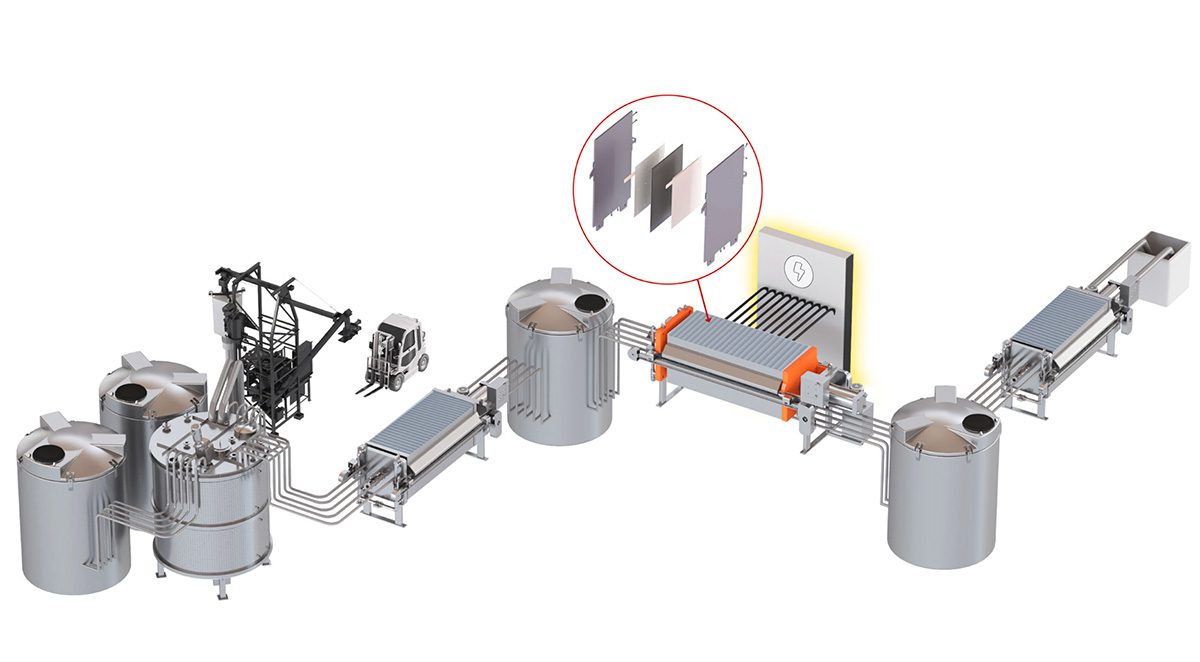
Technical Extraction: What the Article Is Actually Describing
The article is not primarily about EV cell design, but about critical mineral refining for battery supply chains—specifically rare earth electro-extraction and recycled feedstock processing. From an engineering standpoint, the core technology is a closed-loop electrochemical separation/refining process intended to replace conventional precipitation chemistry in rare earth oxide production.
However, the article explicitly references battery-grade lithium carbonate, mixed hydroxide precipitate (MHP), black mass, nickel, cobalt, and copper, so the relevant battery-industry implications are tied to downstream cell chemistries and their manufacturability, not to a specific cell architecture described in the story.
Below is a technical analysis of the battery-relevant content, with the chemistry assumptions and thermal/fast-charge implications inferred from the mentioned materials.
1) Assumed Cell Chemistry and Intrinsic Limitations
Most Likely Cell Chemistry Context: LFP and NMC Ecosystems
The article does not identify a specific cathode chemistry, but the references to:
- black mass
- battery-grade lithium carbonate
- nickel
- cobalt
- copper
- MHP
strongly imply integration into the Li-ion battery recycling and precursor ecosystem, where the dominant chemistries are:
- LFP (LiFePO₄) for high-volume, lower-cost EVs
- NMC (LiNiMnCoO₂), especially high-nickel variants
- to a lesser degree NCA
Because the article emphasizes lithium carbonate from black mass, the downstream product is almost certainly intended for lithium-ion precursor manufacturing, not solid-state cells. Solid-state would require very different electrolyte/solid interface supply chain assumptions and is not implied by the text.
Why LFP and NMC Are the Most Probable Interpretations
LFP
LFP recycling flows do not require nickel or cobalt recovery economics to be viable, but lithium recovery remains valuable. LFP is attractive in China and increasingly in Western EV production because of:
- low cost
- good thermal stability
- long cycle life
- cobalt-free formulation
NMC
Higher energetic density system with strong demand for:
- nickel salts
- cobalt salts
- manganese compounds
- lithium carbonate/hydroxide
The article’s mention of black mass refining and MHP is highly aligned with NMC supply chain economics.
2) Intrinsic Material Limitations by Chemistry
LFP Limitations
From an engineering perspective, LFP’s main constraints are:
- Lower specific energy than high-nickel NMC
- Lower volumetric energy density, which increases pack volume and mass
- Poor low-temperature performance due to reduced lithium-ion transport kinetics and electrolyte viscosity effects
- Higher internal resistance at low SOC and low temperature, limiting charge acceptance
- Voltage plateau behavior around ~3.2 V nominal, which simplifies BMS control but limits energy density
NMC Limitations
For NMC, especially high-nickel compositions such as NMC 811 or 9½½-type formulations, the dominant limitations are:
- Thermal and structural instability at high SOC
- Surface reconstruction and microcracking
- Accelerated electrolyte parasitic reactions
- Transition metal dissolution
- Oxygen release risk at elevated temperature / high state-of-charge
- More difficult fast-charge window management, especially at low temperature
High-nickel cathodes increase specific energy, but they also increase:
- sensitivity to heat
- need for tighter thermal gradients
- dependence on coating quality and particle morphology
- failure risk under aggressive charge protocols
Solid-State Limitations
Solid-state is not implied by the article, but for completeness:
- interfacial impedance remains a fundamental challenge
- stack pressure requirements complicate pack design
- dendrite penetration can still occur
- ceramic electrolytes have low room-temperature interfacial transport in practical implementations
- manufacturing yield and moisture sensitivity remain barriers
Nothing in the article indicates solid-state relevance.
3) Thermal Management Challenges Inferred at the Cell and Pack Level
Although the article is about refining, the downstream battery-grade outputs affect cell manufacturing. If these refined materials are used in modern EV packs, thermal management requirements depend heavily on the cathode choice.
Heat Generation Mechanisms in Li-Ion Cells
During operation, heat arises from:
- ohmic losses in electrolyte, separators, current collectors, and tabs
- entropic heat from electrochemical reactions
- polarization losses under high C-rate charging/discharging
- side reactions at elevated temperature and high SOC
The thermal burden increases sharply during fast charging because I²R losses scale nonlinearly with current, and charge-transfer resistance rises at unfavorable temperature/SOC conditions.
Liquid Cooling Plate Design Constraints
For EV packs using LFP or NMC cells, the liquid cooling architecture is often the dominant thermal bottleneck.
Key engineering variables:
- coolant channel geometry
- plate-to-cell contact resistance
- thermal interface material conductivity
- serpentine vs. parallel channel routing
- pressure drop and pump power
- local hot spot suppression
Design challenge:
A cooling plate can remove average heat effectively while still allowing cell-to-cell thermal gradients if:
- coolant distribution is uneven
- edge cells receive more convective coupling than center cells
- contact pressure varies across modules
- cell swelling changes interface resistance over time
This is especially important in large-format pouch or prismatic cells, where cell surface area is large and center-plane heat removal becomes difficult.
Thermal Gradient Management
Large thermal gradients can cause:
- nonuniform aging
- local impedance increase
- differential lithium plating risk
- unequal SOC distribution across parallel groups
- accelerated binder decomposition in hot zones
For high-nickel NMC, local hot spots are more problematic because the chemistry is less thermally tolerant.
Tab Cooling vs. Surface Cooling
Surface cooling
Most common in prismatic or pouch modules and sometimes cylindrical sidewall systems.
Advantages:
- simpler architecture
- good average heat extraction
- mature manufacturing integration
Limitations:
- interior heat path can be long
- poor handling of tab hot spots
- risk of nonuniform heat flux through thick electrodes
Tab cooling
Especially relevant for fast charge because current enters/exits through tabs, making them a localized heat source.
Advantages:
- directly targets current bottlenecks
- reduces hottest electrical boundary region
- can lower resistive heating during aggressive charge
Limitations:
- difficult to implement without mechanical and electrical complexity
- localized cooling can create thermal gradients if overapplied
- may not solve bulk electrode heat generation
High-Level Thermal Conclusion
For LFP, thermal management is more forgiving but pack-wide uniformity is still crucial.
For NMC, thermal design must be tightly controlled to avoid:
- hotspot-driven degradation
- calendar aging acceleration
- thermal runaway propagation risk
4) Fast-Charging Constraints: Ionic Transport and Lithium Plating
Why Fast Charging Is Fundamentally Limited
Fast charging is constrained by the cell’s ability to transport lithium ions through:
- electrolyte bulk
- porous separator
- tortuous electrode pores
- solid-state diffusion in active particles
- charge-transfer interfaces
The practical limit is not simply charger power; it is the cell’s electrochemical transport margin.
Ionic Conductivity Constraints
Electrolyte ionic conductivity declines effectively under:
- low temperature
- high viscosity solvent systems
- salt concentration extremes
- poor wetting or electrolyte starvation in thick electrodes
If the lithium-ion transport rate cannot keep up with the applied current, concentration gradients form at the anode/electrolyte interface.
Lithium Plating Risk
Lithium plating occurs when the graphite anode potential drops to near 0 V vs. Li/Li⁺ during charge, causing metallic lithium deposition instead of intercalation.
Risk factors:
- low temperature
- high C-rate
- high SOC
- aged cells with increased impedance
- thick electrodes
- poor thermal uniformity
- high current density at tab-adjacent regions
Consequences:
- loss of cyclable lithium
- dendritic lithium growth
- increased impedance
- potential internal shorting
- accelerated cell aging and safety risk
Cathode-Dependent Fast-Charge Behavior
LFP
LFP can be robust in cycle life, but fast charging is still limited by:
- graphite anode kinetics
- electrolyte transport
- voltage flatness near full charge, which complicates SOC estimation
Its lower cell voltage also means higher current for equivalent power, increasing resistive losses.
NMC
NMC can deliver higher energy density, but at rapid charge:
- higher operating voltage increases side-reaction sensitivity
- cathode-Electrolyte interphase instability becomes more severe
- heat generation often rises faster than in LFP systems
- plating risk at the anode remains the same fundamental limit
5) Process Engineering Relevance of the Article to Battery Supply Chains
Why the Refining Technology Matters to Cell Performance
Although electro-extraction is a mineral-processing technology, it influences downstream battery performance by controlling:
- precursor purity
- trace impurity levels
- metal stoichiometry accuracy
- contaminant species that poison cathode performance
Trace contaminants such as:
- Na
- Ca
- Fe
- Cu
- alkali residuals
- chlorine/sulfur species
can materially affect:
- cathode capacity retention
- gas evolution
- impedance growth
- coating quality
- cycle life consistency
Closed-Loop Electro-Extraction vs. Precipitation
The article indicates replacement of oxalic-acid precipitation with an electro-extraction closed-loop process. Engineering implications include:
- reduced reagent consumption
- tighter selectivity potential
- lower chemical inventory handling
- potentially lower impurity introduction
- improved process controllability
For battery materials, material cleanliness directly impacts cell-to-cell variation and electrochemical reliability.
6) Engineering Bottom Line
What the article implies for battery technology
The relevant battery insight is not a new cell architecture, but a materials supply chain strategy that supports wider deployment of Li-ion chemistries, especially:
- LFP, where lithium carbonate quality and cost are important
- NMC, where lithium carbonate plus nickel/cobalt precursor purity are critical
Most likely chemistry assumption
- Primary assumption: LFP/NMC lithium-ion cells
- Not enough evidence for solid-state
- No direct indication of a novel electrolyte or thermal architecture
Key technical constraints
LFP
- lower energy density
- poor low-temperature charge acceptance
- current demand can still be high due to lower voltage
NMC
- higher energy density but worse thermal stability
- stricter thermal uniformity requirements
- more sensitive to aggressive fast charging and elevated SOC
Fast charge common limitation
- anode-limited lithium intercalation
- ionic transport bottlenecks
- lithium plating at low temperature/high C-rate
Thermal management takeaway
Any supply chain that enables more NMC and LFP deployment must still accommodate:
- liquid cooling plate optimization
- cell-to-cell thermal homogenization
- tab-region hotspot mitigation
- pack-level dynamic derating under fast charge
If you want, I can also turn this into a cell teardown style memo with:
- chemistry identification confidence level
- expected electrode stack architecture
- probable cooling plate / module construction
- failure modes and test plan for validation