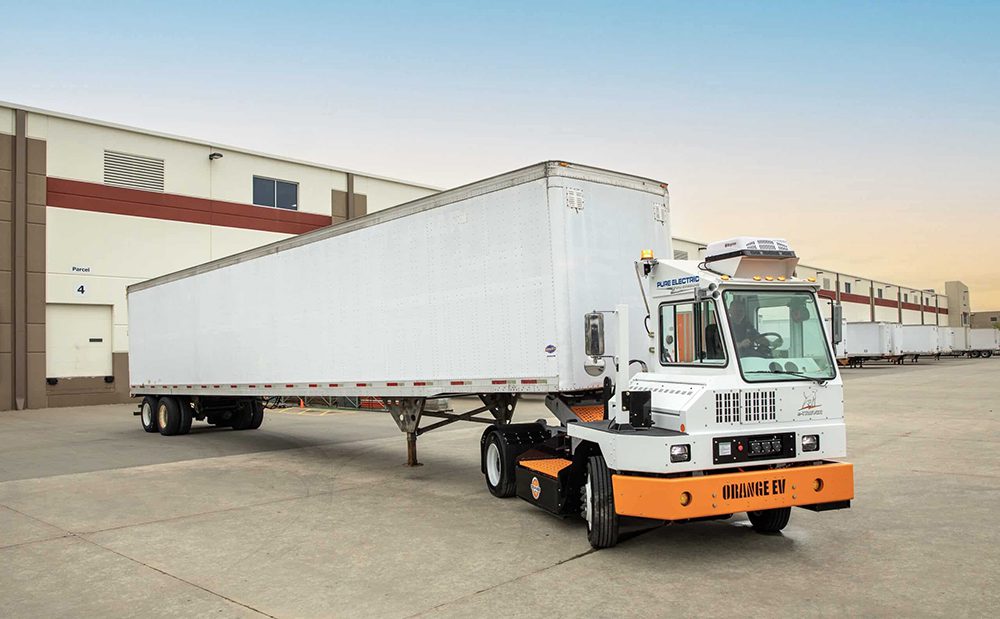
Engineering Analysis of Orange EV’s Yard Truck Platform Battery Implications
The article provides no explicit battery specification, but the vehicle class and deployment context strongly constrain the likely electrochemical architecture and thermal design envelope. A Class 8 terminal tractor operating in a yard/intermodal duty cycle prioritizes high cycle life, robust power delivery at low-to-moderate speeds, opportunity charging compatibility, and extremely high uptime over maximum energy density. From an engineering standpoint, that almost always points toward a lithium iron phosphate (LFP)-based traction battery rather than high-nickel NMC or emerging solid-state systems.
1) Assumed Cell Chemistry and Intrinsic Limitations
Most Probable Chemistry: LFP
For heavy-duty yard trucks, LFP is the most plausible chemistry because it offers:
- Excellent cycle life under frequent partial-state-of-charge operation
- Superior thermal stability versus layered oxide cathodes
- Lower material cost and reduced cobalt/nickel dependence
- Tolerant high-power discharge behavior for stop-start terminal duty
- Operational durability under repetitive fleet use, where TCO dominates
Yard tractors typically accumulate many shallow cycles per day rather than long-range energy-depleting cycles. This duty profile aligns well with LFP’s strengths.
Why Not NMC as the Primary Assumption?
NMC could theoretically be used, but its limitations are more severe for this application:
- Higher thermal reactivity at elevated SOC and temperature
- Greater sensitivity to abuse conditions
- Typically more demanding thermal management
- Higher capex and supply-chain exposure due to nickel/cobalt content
NMC would only be attractive if Orange EV were aggressively chasing pack-level energy density, which is less critical in a yard tractor than in a long-haul BEV.
Why Solid-State Is Unlikely in This Context
Solid-state remains largely immature for commercial fleet deployment, especially in a high-utilization Class 8 platform. Intrinsic barriers include:
- Interfacial impedance stability over life
- Manufacturing scalability
- Stack pressure management
- Dendrite suppression under fast charging
- Unproven durability in vibration-intensive commercial use
For a 600-unit order requiring near-term delivery and field reliability, solid-state is not a realistic production assumption.
Intrinsic LFP Limitations
Despite being the best fit, LFP has engineering tradeoffs:
Lower gravimetric and volumetric energy density
Compared with NMC, LFP typically needs more cell mass and volume for the same usable kWh. This affects:
- Pack packaging efficiency
- Vehicle curb mass
- Auxiliary structural requirements
- Space available for thermal hardware
For a yard truck, this is usually acceptable because range requirements are modest, but it still constrains system integration.
Flat voltage plateau complicates SOC estimation
LFP’s OCV-SOC curve is relatively flat over much of the usable range, which makes:
- Coulomb-counting drift harder to detect
- Voltage-based SOC estimation less informative
- Calibration more dependent on model-based BMS algorithms
In fleet duty, accurate SOC prediction is essential for dispatch planning and opportunity charging.
Low-temperature performance degradation
LFP suffers from reduced ionic mobility and increased interfacial resistance at low temperature. Consequences include:
- Power fade in cold conditions
- Slower charge acceptance
- Heightened lithium plating risk during fast charging
- Need for preconditioning or battery heating
For outdoor yard operations in North America, this is a material issue.
Moderately lower intrinsic rate capability than some layered oxides
Although LFP can be formulated for high power, its Li-ion diffusion kinetics and electronic conductivity are not inherently as favorable as one might assume without carbon coating and conductive network optimization. High-power operation is usually achieved through cell engineering, not chemistry alone.
2) Theoretical Thermal Management Challenges
Duty-Cycle Thermal Profile in Yard Trucks
Unlike highway tractors, terminal tractors experience:
- Repeated short acceleration events
- Low-speed maneuvering
- Frequent idle/standby transitions
- Opportunity charging or depot charging
- Ambient exposure in warehouse yards, ports, and intermodal terminals
This creates a thermal profile characterized by localized heat generation with intermittent steady-state periods, which is difficult for conventional cooling strategies to handle efficiently.
Cell-Level Heat Generation Mechanisms
Heat in lithium-ion cells is composed of:
- Ohmic heating: I²R losses in current collectors, electrodes, interconnects, and busbars
- Reaction heat: overpotential-related irreversible heat
- Entropic heat: SOC- and temperature-dependent reversible component
- Contact resistance heat: tab welds, module interconnects, and even cooling interface pressure variation
In a heavy-duty application, peaks during acceleration and charging can create substantial thermal gradients if the pack design is not carefully balanced.
Liquid Cooling Plate Design Constraints
If the pack uses liquid cooling, the cooling plate architecture becomes a primary determinant of thermal uniformity.
Coolant path optimization
A basic serpentine or parallel-channel plate may be insufficient for a large-format commercial pack because:
- Coolant inlet/outlet temperature rise induces longitudinal gradients
- Parallel channel maldistribution can leave low-flow regions undercooled
- Pressure drop constraints limit achievable mass flow rate
- Dead zones near corners or module ends can develop high local temperatures
A properly engineered design requires:
- Balanced hydraulic distribution
- Short thermal path from cell to cold plate
- Mechanically stable stack pressure
- Leak-resistant manifolds suitable for vibration and contamination exposure
Interface thermal resistance
Even with a cold plate, the true bottleneck is often the stack-up resistance between cell can, gap filler, adhesive, module baseplate, and coolant plate. Poor interface design creates:
- High peak cell-core temperature
- Large module-to-module delta-T
- Uneven aging across the pack
For fleet operators, uneven aging translates directly into reduced usable life and inconsistent vehicle performance.
Thermal Gradients and Aging Nonuniformity
Thermal gradients are not just a safety concern; they accelerate degradation.
Consequences of delta-T
Cells operating hotter than their neighbors will see:
- Faster SEI growth
- Accelerated electrolyte decomposition
- Greater capacity fade
- Higher impedance rise
- SOC imbalance over time
In an LFP pack, where voltage response is already relatively flat, temperature-induced impedance divergence can complicate BMS balancing and fault diagnosis.
Practical thermal uniformity target
For heavy-duty battery packs, maintaining low intra-pack thermal spread is crucial. If the cooling architecture allows a persistent gradient, the pack will age according to the worst-cooled cells, not the average.
Tab Cooling vs Surface Cooling
This is a critical engineering choice.
Surface cooling
Surface cooling through the cell can or cell module wall is the most common approach. Advantages:
- Simpler manufacturability
- Large contact area
- Better compatibility with pouch or prismatic modules
Limitations:
- Heat must travel through the cell stack to the surface
- Core temperature can be significantly higher than case temperature
- At high charge/discharge power, the center of the electrode stack becomes the thermal hotspot
For prismatic LFP cells, surface cooling often leaves the core thermally lagging behind the case.
Tab cooling
Tab cooling directly extracts heat near the current collector tabs, where current density and resistive losses are often concentrated. Advantages:
- Addresses a primary hotspot source
- Can reduce local tab temperatures and weld stress
- Potentially lowers peak temperature at high C-rates
However, tab cooling is also challenging because:
- Tabs are small thermal mass regions with complex mechanical constraints
- Contact quality must be highly controlled
- It may not sufficiently cool the electrochemical core
- It can be difficult to scale economically in rugged commercial packaging
Best-Theoretical Solution for This Duty Cycle
For a terminal tractor battery pack, the optimal thermal architecture is often a hybrid model:
- High-conductivity module baseplate or cold plate for bulk heat removal
- Localized thermal reinforcement near tabs/busbars
- Carefully managed coolant flow to minimize module-to-module temperature spread
- Pack preconditioning for cold-weather charging
- BMS logic that derates power based on cell core temperature, not only surface temperature
This is especially important if the fleet uses rapid depot charging between shifts.
3) Fast-Charging Constraints
Why Fast Charging Matters Here
A yard truck is a utilization asset, not a long-range transport asset. Fleet operators value:
- Fast turnarounds
- Multi-shift availability
- Charging-in-window capability
- Minimal queue time at the charger
As a result, the battery system must tolerate repeated high C-rate charging without rapid capacity loss.
Ionic Conductivity Limits
Fast charging is constrained by the full transport chain:
- Electrolyte ionic conductivity
- Li+ diffusion in the solid electrolyte interphase
- Li+ diffusion through the active material particles
- Charge transfer kinetics at the electrode/electrolyte interface
At high C-rates, the cell becomes transport-limited. If the anode cannot intercalate lithium quickly enough, lithium ions accumulate at the surface rather than entering graphite safely.
Lithium Plating Risk
Lithium plating is the major failure mode during aggressive charging, especially at:
- Low temperature
- High SOC
- High charge current
- Elevated cell impedance due to aging
- Cells with uneven thermal distribution
When the anode potential drops too close to 0 V vs. Li/Li+, metallic lithium deposits instead of intercalating into graphite.
Why this matters in fleet service
Lithium plating can cause:
- Irreversible lithium loss and capacity fade
- Dendrite growth and internal short risk
- Gas generation
- Accelerated impedance increase
- Energetic safety concerns over time
In commercial deployments, even subcritical plating that does not trigger immediate failure can substantially reduce pack life and warranty economics.
LFP-Specific Fast-Charging Behavior
LFP cathodes are intrinsically stable, but fast-charge performance is still limited by the graphite anode and cell thermal state. Important issues include:
- Lower operating voltage reduces energy-per-cell, so packs may need more series/parallel complexity
- Cold charge acceptance is poor without preheating
- Voltage response during charge is relatively flat, making it harder for the BMS to infer local overcharge risk
- High-power charging requires excellent cell matching and thermal uniformity
Thus, LFP is not “fast-charge immune”; it simply offers a more forgiving thermal and safety envelope than NMC.
Engineering Mitigations for Fast Charging
A fleet-grade system typically uses:
- Charge current tapering based on cell temperature and impedance
- Battery preconditioning before DC fast charging in cold weather
- SOC window management, avoiding frequent charging to very high SOC
- Accurate thermal sensing distributed across modules, not a single point estimate
- Chemistry-aware BMS algorithms to prevent plating-inducing charge schedules
For yard operations, the optimal strategy is often frequent partial charging rather than deep fast charging to 100% SOC.
System-Level Interpretation
The scale of the order suggests Orange EV’s battery engineering challenge is less about pushing maximum energy density and more about sustaining fleet-level reliability under high-duty-cycle operation. That means the battery pack must be engineered for:
- Thermal uniformity
- High cycle life
- Rapid depot charging with controlled degradation
- Robust BMS estimation in a flat-voltage chemistry
- Mechanical durability under vibration, shock, and contamination
If the platform is indeed LFP-based, the chemistry choice is rational for the application, but it imposes nontrivial demands on thermal management and fast-charge control. The success of the vehicle will depend less on nominal pack kWh and more on how well the pack mitigates thermal gradients, charge-induced lithium plating, and long-term impedance growth.
Conclusion
From an engineering perspective, the article implies a fleet-optimized LFP battery architecture likely tuned for duty-cycle durability rather than range. The primary technical challenges are:
- LFP’s lower energy density and cold-temperature limitations
- Managing thermal gradients in a heavy-duty liquid-cooled pack
- Avoiding local hotspots at tabs and interconnects
- Preventing lithium plating during high-C-rate charging
- Maintaining BMS accuracy in a chemistry with a flat voltage plateau
For terminal tractors, battery success is fundamentally a thermal and electrochemical reliability problem, not merely an energy-storage problem.