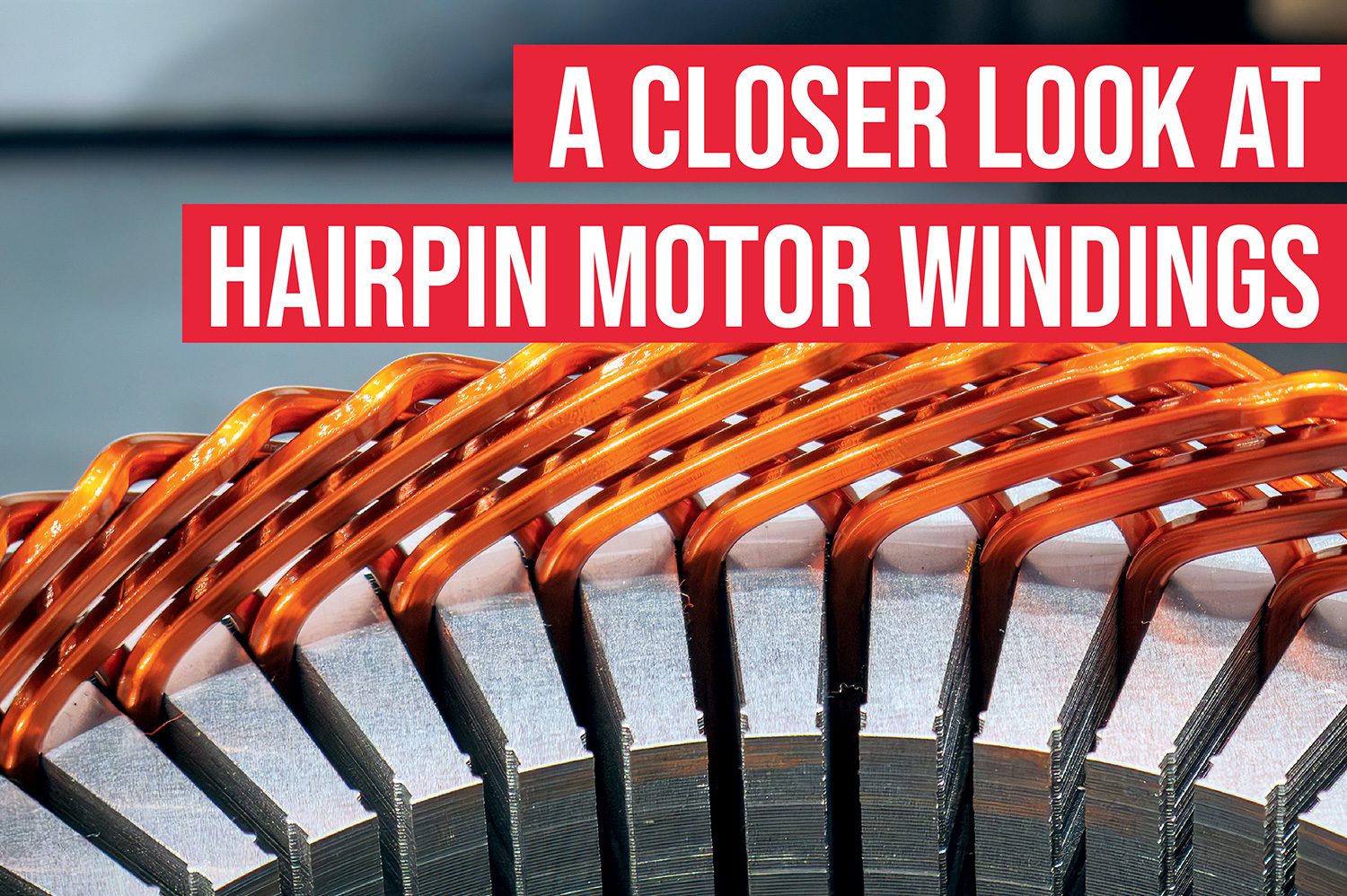
Core Technology Extracted: Hairpin Stator Windings for EV Traction Motors
The article is primarily about hairpin winding architecture in EV traction motors—not battery technology. However, because traction motor performance, inverter operating envelope, and pack-level thermal strategy are tightly coupled in an EV powertrain, the hairpin discussion maps directly onto the same engineering constraints that govern battery chemistry selection, thermal management, and fast-charging limits.
From a teardown and system-integration perspective, the core technology is a high-copper-fill, rectangular-conductor stator winding topology intended to improve current density, reduce copper loss at selected operating points, and lower manufacturing cost per kW via automated forming, insertion, and welding processes.
1) Assumed Cell Chemistry Context and Intrinsic Limitations
System-level assumption
The article explicitly references a 400 VDC architecture, which is typical of mainstream EV platforms using either:
- NMC/NCA-based lithium-ion packs for higher energy density,
- LFP-based packs for lower cost and improved cycle life,
- less commonly, emerging solid-state concepts.
Since the article focuses on motor winding current, voltage, and losses, the implied pack is a conventional high-voltage lithium-ion traction battery rather than a niche ultrahigh-voltage architecture. For engineering analysis, the most likely chemistry splits are:
- NMC/NCA if vehicle targets require high specific energy and lower pack mass
- LFP if the cost target favors durability and thermal robustness over volumetric energy density
Relevance of chemistry to the motor discussion
The hairpin winding argument is really about electrical machine impedance matching to the battery/inverter ecosystem. A motor with lower winding resistance and improved slot fill can exploit higher phase current, but the battery chemistry determines how sustainably that current can be supplied.
LFP intrinsic limitations
If the pack is LFP, the key constraints are:
- Lower nominal cell voltage (~3.2 V) and lower pack energy density than NMC
- Reduced low-temperature power capability
- Higher polarization at low SOC and low temperature
- Slower usable charge acceptance when cold, due to lithium-ion diffusion limits in the olivine structure and electrolyte transport losses
For an EV traction system, this means LFP pairs well with hairpin motors in duty cycles emphasizing cost and durability, but it can become the bottleneck under aggressive acceleration + regenerative events if pack temperature is not tightly managed.
NMC/NCA intrinsic limitations
If the pack is NMC/NCA, the dominant limitations are:
- Thermal instability margin is narrower than LFP
- Greater sensitivity to high C-rate stress
- Accelerated aging from high SOC / high temperature exposure
- Lithium plating risk rises sharply during fast charge at low temperature
- Cathode structural degradation and electrolyte oxidation at elevated voltage
NMC/NCA supports higher energy density, which is helpful for maintaining power at 400 V with reasonable mass, but the thermal envelope is tighter. This matters because a low-loss hairpin motor can shift more of the vehicle’s thermal burden onto the battery during high-power operation.
Solid-state limitation set
If the article were to be mapped onto a solid-state concept, the battery-side limitations would shift to:
- Interfacial impedance
- Contact retention under cycling
- Dendrite suppression challenges
- Stack pressure sensitivity
- Lower-power performance at temperature extremes
Solid-state cells would not eliminate the powertrain bottlenecks discussed in the article because the inverter and motor still impose high dynamic current transients. They would, however, change the charge acceptance and thermal strategy dramatically.
2) Hairpin Windings: Electrical and Electromagnetic Implications
Why hairpin exists
Hairpin windings improve the copper packing factor in stator slots, typically from roughly 55% for traditional round-wire windings to around 70% in well-optimized hairpin implementations. This matters because:
- reduced slot void fraction lowers DC resistance
- higher copper cross-section increases ampacity
- geometric regularity is better suited to automation
- stator resistance reduction can improve peak torque and efficiency in certain regions
But the gains are not free
Hairpin conductors are typically rectangular or square copper segments, which reduce the effective winding flexibility and create new losses:
- AC resistance rises from skin and proximity effects
- end-turn geometry becomes less compact
- distributed winding must be used because hairpins cannot easily form tight-radius concentrated windings
- joining joints become electrical and thermal weak points
Frequency-dependent loss behavior
The article correctly notes skin depth in copper as a function of frequency. At higher electrical frequency, current crowds toward the conductor surface, increasing effective resistance. For large-section hairpins, this means:
- the full copper area is not always electrically utilized
- AC copper loss may approach or exceed the DC copper loss at elevated electrical frequency
- benefits of increased conductor area saturate with speed
This is why hairpin technology is most attractive where the machine is designed around a specific base speed / propulsion envelope rather than broad, highly variable frequency operation.
3) Theoretical Thermal Management Challenges
Even though the article is motor-centric, the thermal architecture lessons are directly analogous to battery pack design.
3.1 Liquid cooling plate design tradeoffs
A hairpin stator and an EV battery pack both rely on heat extraction across finite thermal interfaces. For batteries, the analog is a liquid cooling plate under the module or cell array. The key design variables are:
- channel geometry
- coolant Reynolds regime
- plate-to-cell contact resistance
- manifold flow distribution
- thermal spreading within the plate
- pressure drop vs. pumping loss
In a battery pack, just as in a hairpin stator, the chief risk is thermal nonuniformity. A high-copper-fill stator may still develop hot spots at the welds or end windings; similarly, a battery module may appear well cooled on average but hide cell-to-cell gradients that accelerate divergence in aging and impedance.
3.2 Thermal gradients and local hotspot formation
For traction battery packs, the most damaging gradients are typically:
- through-thickness gradients within pouch/prismatic cells
- along-module gradients between inlet and outlet coolant regions
- cell-to-cell differences due to compression, contact resistance, and local airflow/liquid flow variation
From a teardown standpoint, the analogous motor issue is the end-turn and weld-zone hotspot. Hairpin windings concentrate thermal stress at:
- welded joints
- bent end-turns
- interface between conductor and slot liner
- localized regions of altered grain structure / metallurgical weakness
For the battery, a similar effect occurs near tabs, jellyroll edges, and current collector transitions.
3.3 Tab cooling vs. surface cooling
This is especially important in high-power cells.
Surface cooling
Surface cooling prioritizes extraction through the largest area of the cell can or pouch face. Advantages:
- lower interface resistance
- simpler mechanical design
- better uniformity for prismatic/pouch cells
- reduced local thermal flux concentration
Limitations:
- poor handling of internal heat generation when current density is high
- slower response to transient peaks
- may leave tab regions undercooled
Tab cooling
Tab cooling targets the current collector exit points, where overpotential heating can be severe under high current. Advantages:
- directly attacks current-constriction heat
- useful for fast charge and high discharge pulses
Limitations:
- tab carries high current density but low thermal mass
- mechanically difficult to cool without adding resistance or fatigue risk
- can create a thermal sink that reduces local temperature while mid-plane cell regions remain hot
For a battery supporting aggressive power delivery to a hairpin-driven traction system, tab-region thermal management is critical during both:
- regen bursts
- fast charge
because current density and ionic flux are highest at the terminal regions.
3.4 Why thermal management becomes harder with hairpin motors
Hairpin motors reduce some copper loss at certain operating points, but they also enable more aggressive continuous current and peak current operation. That tends to:
- increase inverter switching and conduction losses under load
- increase battery transient current demand
- shift thermal bottlenecks from the motor windings to the battery and power electronics
Thus, if the drive unit is optimized for higher phase current, the pack must be designed with:
- lower internal resistance
- better heat removal from electrodes and tabs
- tighter cell matching
- more robust coolant flow distribution
4) Fast-Charging Constraints
4.1 Ionic conductivity as the first-order limiter
Fast charging is fundamentally constrained by ionic transport through electrolyte and porous electrodes, plus charge transfer kinetics at the interfaces. As C-rate rises:
- electrolyte concentration gradients build up
- separator ionic resistance becomes more significant
- solid-state diffusion in particles becomes rate-limiting
- polarization increases
- cell voltage reaches cutoff before full lithiation is achieved
In practical terms, the battery cannot accept charge at arbitrarily high power just because the motor/inverter side can support it.
4.2 Lithium plating risk at high C-rates
The major failure mode under fast charge, especially at low temperature, is lithium plating on the graphite anode. This occurs when:
- anode potential drops too close to 0 V vs Li/Li⁺
- diffusion into graphite cannot keep pace with intercalation demand
- surface concentration gradients become excessive
Plating consequences include:
- loss of cyclable lithium
- impedance rise
- dendritic growth risk
- separator damage in severe cases
- accelerated fade and safety degradation
High C-rate charging is especially problematic for NMC/NCA/graphite packs due to the combination of higher energy density and tighter thermal margins. LFP/graphite can be more tolerant thermally, but still suffers plating if temperature and SOC window are unfavorable.
4.3 Temperature dependence
Fast-charge acceptance is highly temperature-sensitive:
- Cold cells: higher impedance, stronger plating risk
- Warm but not overheated cells: better kinetics, improved diffusion
- Overheated cells: faster aging, electrolyte decomposition risk
This creates a narrow optimal window. A well-designed liquid cooling plate must therefore support not just peak cooling, but temperature preconditioning and uniformity control.
4.4 Interaction with powertrain topology
A robust hairpin motor can demand substantial phase current, but on the supply side the battery management system must limit:
- pack current
- cell current imbalance
- temperature rise
- voltage sag
If the pack chemistry cannot support the required current envelope, the entire drivetrain will be derated regardless of motor capability. That is why the motor-side advantage of hairpin windings only materializes when the battery can sustain:
- low DC internal resistance
- low polarization under load
- fast thermal recovery
- acceptable cycle life under high C-rate usage
5) Manufacturing and Reliability Implications Relevant to Battery Engineers
Interconnect joining analogies
The hairpin article emphasizes welding quality, porosity, and joint reliability. The battery equivalent is:
- busbar weld quality
- tab-to-busbar joint resistance
- heat-affected zone embrittlement
- microcrack formation under vibration and thermal cycling
In both cases, the “best” conductor geometry can be invalidated by poorly controlled joining processes.
Vibration and fatigue
Hairpin winding systems must survive mechanical vibration and thermal cycling. Likewise, battery modules must manage:
- compression retention
- weld fatigue
- tab metal fatigue
- adhesive degradation
- cell expansion/contraction
The more aggressive the powertrain, the more important these second-order failure modes become relative to pure electrochemistry.
6) Engineering Conclusion
The article’s real technical lesson is that hairpin windings are an electromagnetic manufacturing optimization, not a universal traction-motor upgrade. Their benefits—higher slot fill, improved automation potential, and higher current capacity—are meaningful only when the rest of the vehicle system can support the resulting thermal and electrical stress.
From the battery engineering standpoint:
- LFP offers thermal robustness and cycle life, but lower energy density and weaker low-temperature fast-charge performance.
- NMC/NCA offers higher energy density and strong power potential, but tighter thermal and plating constraints.
- Solid-state remains constrained by interface, pressure, and rate-performance realities.
Across all chemistries, the key bottlenecks remain:
- electrolyte transport and ionic conductivity
- thermal gradient control
- local hotspot suppression
- lithium plating avoidance during fast charge
- interface reliability at tabs, welds, and busbars
In short, hairpin winding improvements in the drivetrain do not reduce the physics governing the battery. They simply shift the burden upstream onto the pack, where electrochemical kinetics and thermal management determine whether the vehicle can actually exploit the motor’s electrical capability.