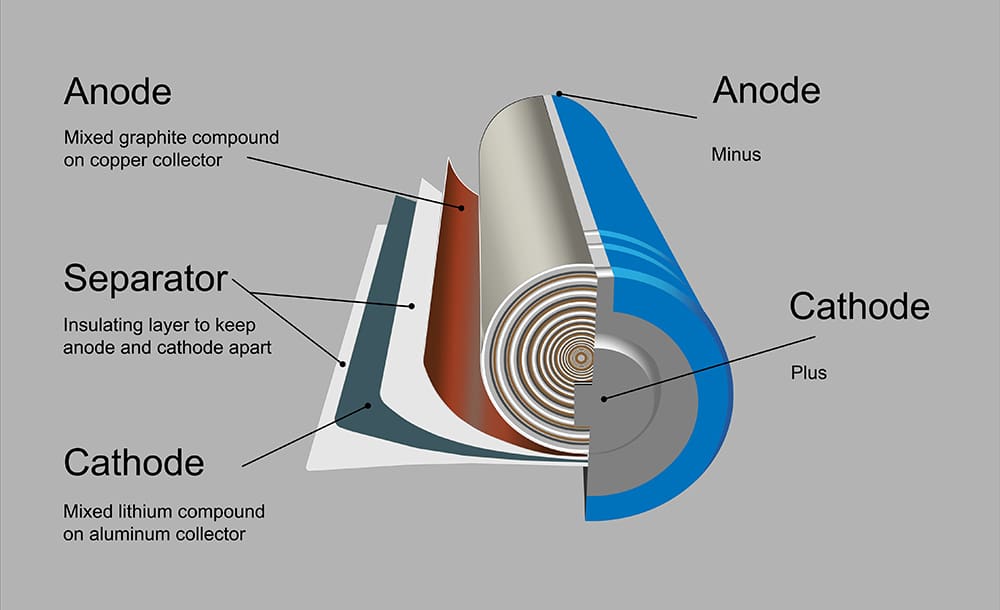
Core Technology Extracted
The article is primarily about graphite-based EV battery anode materials manufacturing, not cell assembly. The core technology is the supply of synthetic/processed graphite active anode material for lithium-ion batteries, with product variants optimized for:
- Energy storage
- Fast charging
- High energy density
From an engineering standpoint, this is a materials-enablement story: the anode formulation, particle morphology, graphitization quality, surface treatment, and porosity control directly affect cell initial efficiency, rate capability, low-temperature performance, cycle life, and lithium plating tolerance.
Because the article does not specify a cathode chemistry, the most defensible assumption is that these anode materials are intended for mainstream lithium-ion cells, most likely NMC/graphite and possibly LFP/graphite formats for EV and stationary storage.
Assumed Cell Chemistry and Intrinsic Limitations
Most likely chemistry: Graphite anode paired with NMC or LFP cathodes
The article references “lithium-ion battery applications in EVs and grid storage” and a product line split into energy storage, fast-charging, and high-energy-density grades. That is consistent with:
- NMC/graphite for high-energy EV platforms
- LFP/graphite for cost, safety, and stationary storage
- Possibly high-silicon blended graphite in premium fast-charge implementations, though not explicitly stated
Why graphite matters here
Graphite remains the industry baseline anode because it offers:
- High reversible intercalation stability
- Mature manufacturing
- Predictable SEI behavior
- Reasonable first-cycle efficiency compared with many alternatives
However, graphite also imposes hard performance ceilings:
- Low potential vs. Li/Li+: Most graphite lithiation occurs near 0.1 V, leaving very little electrochemical margin before lithium plating occurs.
- Layered diffusion limitation: Li diffusion into graphite galleries becomes rate-limiting at high C-rate, especially when particle size, binder distribution, and electrode tortuosity are not optimized.
- Temperature sensitivity: Low-temperature charging sharply increases plating risk due to slower solid-state diffusion and higher charge-transfer resistance.
- SEI fragility: Rapid charge/discharge and high surface area increase SEI growth, consuming cyclable lithium and raising impedance.
If paired with NMC
For NMC/graphite cells, the anode must absorb charge at a rate compatible with the cathode’s nominal kinetics. Fast charge is often limited not by cathode insertion kinetics, but by anode potential collapse toward 0 V vs. Li/Li+, particularly under:
- cold conditions
- high SOC
- elevated current density
- thick electrodes
- aged cells with increased resistance
NMC also places more severe thermal demands on the pack because of:
- higher operating voltage
- higher energy density
- greater heat generation during aggressive charging
- intrinsically narrower safety margin than LFP
If paired with LFP
For LFP/graphite cells, safety is improved, but the system faces different limitations:
- lower cell voltage reduces energy density
- highly flat OCV curve makes SOC estimation difficult
- fast charging still remains an anode-limited problem
- lithium plating risk persists even though the cathode chemistry is more thermally stable
LFP does not eliminate graphite anode constraints; it mostly shifts the bottleneck toward electrode engineering and thermal control during charge acceptance.
Intrinsic limitations of solid-state
The article does not describe solid-state batteries, and the facility is clearly targeted at conventional lithium-ion anode materials. If solid-state were relevant, graphite would be far less central because many solid-state architectures use lithium metal or composite anodes. So the mention of graphitized anode capacity strongly suggests conventional liquid-electrolyte cells, not true solid-state.
Anode Materials Engineering Implications
Product segmentation implies different graphite architectures
The three listed output categories suggest tailoring of:
- particle size distribution
- crystallinity and graphitization degree
- tap density
- BET surface area
- pore structure
- surface coating chemistry
- primary particle morphology
Energy storage material
Likely optimized for:
- high cycle life
- lower cost
- stable SEI
- moderate rate capability
This usually means larger particle sizes, lower specific surface area, and higher first-cycle efficiency.
Fast-charging material
Likely optimized for:
- lower diffusion length
- lower electrode tortuosity
- reduced charge-transfer resistance
- improved electrolyte wetting
This often requires smaller or engineered secondary particles, controlled mesoporosity, and surface modifications that suppress plating without excessively increasing SEI growth.
High-energy-density material
Likely optimized for:
- higher tap density
- higher volumetric capacity
- lower porosity
- better calenderability
But this comes with a tradeoff: denser electrodes raise tortuosity and worsen electrolyte transport, which can reduce power capability and increase local overpotentials during fast charge.
Theoretical Thermal Management Challenges
Why anode material choice affects thermal design downstream
Graphite anode selection influences pack thermal behavior indirectly through:
- fast-charge heat generation
- impedance growth with aging
- spatially nonuniform current distribution
- potential lithium plating exotherms under abuse or marginal operating conditions
The better the anode kinetics, the lower the charge polarization and heat generation. However, even optimized graphite still creates significant thermal-management demands in high-power cell formats.
Liquid cooling plate design constraints
For EV cells using graphite-based anodes, the heat rejection architecture is typically dominated by bottom cooling plates, side cooling channels, or module-level cold plates. The key engineering issues are:
1) Heat flux nonuniformity
Fast charging produces spatially uneven heat generation because current density is not uniform across electrode length and width. Tabs, collectors, and current paths generate localized hot spots.
A cooling plate must therefore address:
- peak local flux near tabs
- differential heating across the jelly roll or stacked electrode edges
- transient thermal spikes during constant-current fast charge
2) Through-thickness thermal resistance
Cell-to-coolant thermal impedance is strongly affected by:
- prismatic can geometry
- pouch compression stack
- interface materials
- gap fillers
- contact pressure variability
If the liquid plate only cools one face effectively, large internal gradients can persist, especially in thick-format high-energy cells.
3) Coolant-side hydraulic tradeoffs
A high-performance plate needs:
- high convective coefficient
- low pressure drop
- uniform flow distribution
- corrosion resistance
- manufacturability at scale
Microchannel or serpentine designs improve local heat transfer but can create unacceptable pressure drop, flow maldistribution, or fouling sensitivity.
Thermal gradients are the actual enemy
The biggest problem is not average cell temperature; it is cell-to-cell and intra-cell thermal gradient.
Thermal gradients cause:
- nonuniform SEI growth
- local aging acceleration
- capacity imbalance
- divergence in internal resistance
- localized lithium plating during charge
In graphite anodes, a temperature difference of even a few degrees can materially affect intercalation kinetics. The coldest regions in a cell are the most plating-prone because Li diffusivity and charge-transfer kinetics degrade with temperature.
Tab cooling versus surface cooling
Tab cooling advantages
Cooling the tabs directly can be very effective because tabs are:
- current collection bottlenecks
- localized heat sources
- high-resistance regions under fast charge
Tab cooling lowers:
- ohmic heating at the current collector interfaces
- temperature peaks near current entry points
- local metallurgical stress from thermal cycling
Tab cooling limitations
But tab cooling alone is insufficient because:
- the bulk electrode stack can still remain thermally stratified
- tabs represent only a small fraction of the thermal mass
- electrochemical heat is generated throughout the electrode volume, not just at the tab
Surface cooling advantages
Surface or plate cooling addresses the full cell face and is better for:
- reducing bulk temperature rise
- controlling through-plane gradients
- stabilizing average operating temperature
Surface cooling limitations
Surface cooling can miss:
- internal mid-plane hot spots in thick cells
- edge effects in prismatic and pouch formats
- tab-adjacent heat localization
Best practice: hybrid thermal architecture
For high-rate graphite anode cells, the most robust system is usually a hybrid design:
- face cooling to manage mean temperature
- tab or busbar cooling to suppress current-collector hot spots
- compression control to improve interfacial thermal contact
- software derating based on temperature and SOC
A purely passive or single-sided liquid system is usually insufficient for aggressive fast charge in high-energy cells.
Fast-Charging Constraints
The real bottleneck is anode insertion kinetics
Fast charge is limited by a combination of:
- electrolyte ionic conductivity
- electrode tortuosity
- solid-state diffusion in graphite
- charge-transfer resistance at the SEI
- current collector and tab resistance
- thermal rise during charging
Even if the cathode is capable of accepting high current, the graphite anode often becomes the rate-limiting electrode because it operates so close to the lithium plating threshold.
Ionic conductivity and transport limitations
During charging, Li+ must traverse:
- bulk electrolyte
- separator
- porous anode structure
- SEI
- graphite intercalation sites
At high C-rate, the electrolyte concentration gradient increases, especially in:
- thick electrodes
- low-porosity structures
- high-loading designs
- cold conditions
As electrolyte depletion develops near the anode surface, local overpotential rises. That overpotential pushes the anode potential downward, which can initiate metallic lithium deposition instead of intercalation.
Lithium plating risk
This is the critical failure mode in fast-charge graphite cells.
Conditions that increase plating risk
- high SOC
- low temperature
- high current
- aged cells with elevated impedance
- thick electrodes
- poor thermal uniformity
- insufficient electrolyte wetting
- high tortuosity anode formulations
Mechanism
When the anode potential locally approaches 0 V vs. Li/Li+, additional Li+ cannot intercalate fast enough into graphite galleries. Instead, lithium metal deposits on the surface. Consequences include:
- loss of cyclable lithium
- increased impedance
- dendritic growth risk
- safety degradation
- irreversible capacity fade
- possible internal short formation upon stripping/plating asymmetry
Why “fast-charging graphite” is not just a material as such
A fast-charging anode grade is not simply “more conductive graphite.” It usually requires a full-stack optimization of:
- particle morphology
- edge-plane exposure
- surface coating
- pore hierarchy
- calendering density
- binder distribution
- electrolyte additive compatibility
The objective is to reduce polarization without creating excessive surface area that accelerates SEI growth.
Competition between energy density and fast charge
This is a core tradeoff.
- Higher-density electrodes improve energy density but increase ionic path length and tortuosity.
- Lower-density electrodes improve charge acceptance but reduce volumetric energy density.
- Smaller particles improve kinetics but increase SEI area and irreversible loss.
- Larger particles reduce SEI but hurt diffusion and rate capability.
So the existence of separate “fast-charging” and “high-energy-density” material grades is technically significant: it implies the supplier is targeting different electrode design envelopes rather than a universal product.
Manufacturing and Qualification Implications
Sample delivery to OEMs indicates specification-level validation
Supplying 20 kg samples to OEMs and battery companies implies the anode materials are being evaluated at:
- coin-cell level
- pouch prototype level
- possibly pilot line validation
The testing likely includes:
- first-cycle Coulombic efficiency
- dQ/dV characterization
- rate capability maps
- low-temperature charge acceptance
- swelling behavior
- impedance growth
- gas generation
- calendar aging
- plating detection via voltage relaxation or post-mortem analysis
Critical KPIs likely under evaluation
For a graphite anode supplier, the battery customer will care about:
- surface area vs. ICE tradeoff
- tap density
- irreversible lithium loss
- contamination levels: Fe, Cu, Ni, S, Na, ash
- particle size distribution consistency
- batch-to-batch reproducibility
- electrolyte compatibility
- swelling after formation
- fast-charge plating threshold at specified temperature and SOC windows
Engineering Assessment
This facility is not merely a raw-material plant; it is part of the rate-capability and energy-density value chain for lithium-ion cells. Its technical relevance lies in how graphite microstructure and graphitization quality constrain downstream cell design.
From a battery engineering perspective:
- Graphite remains the dominant anode material
- Its principal limitation is lithium plating at high charge rates
- Thermal uniformity is as important as bulk heat removal
- Fast charging requires integrated optimization of anode morphology, electrode formulation, and pack cooling
The most important implication is that any supplier claiming separate products for energy storage, fast charge, and high energy density is addressing three different electrochemical operating windows, each with distinct tradeoffs in:
- diffusion kinetics
- SEI stability
- volumetric packing
- thermal behavior
- plating margin
In other words, the underlying technology is a graphite anode materials platform engineered to tune the balance between energy density, power capability, and electrochemical safety margin.